Chewing Glass and Staring Into the Abyss: The Real Cost of Entrepreneurship | Moe Abbas
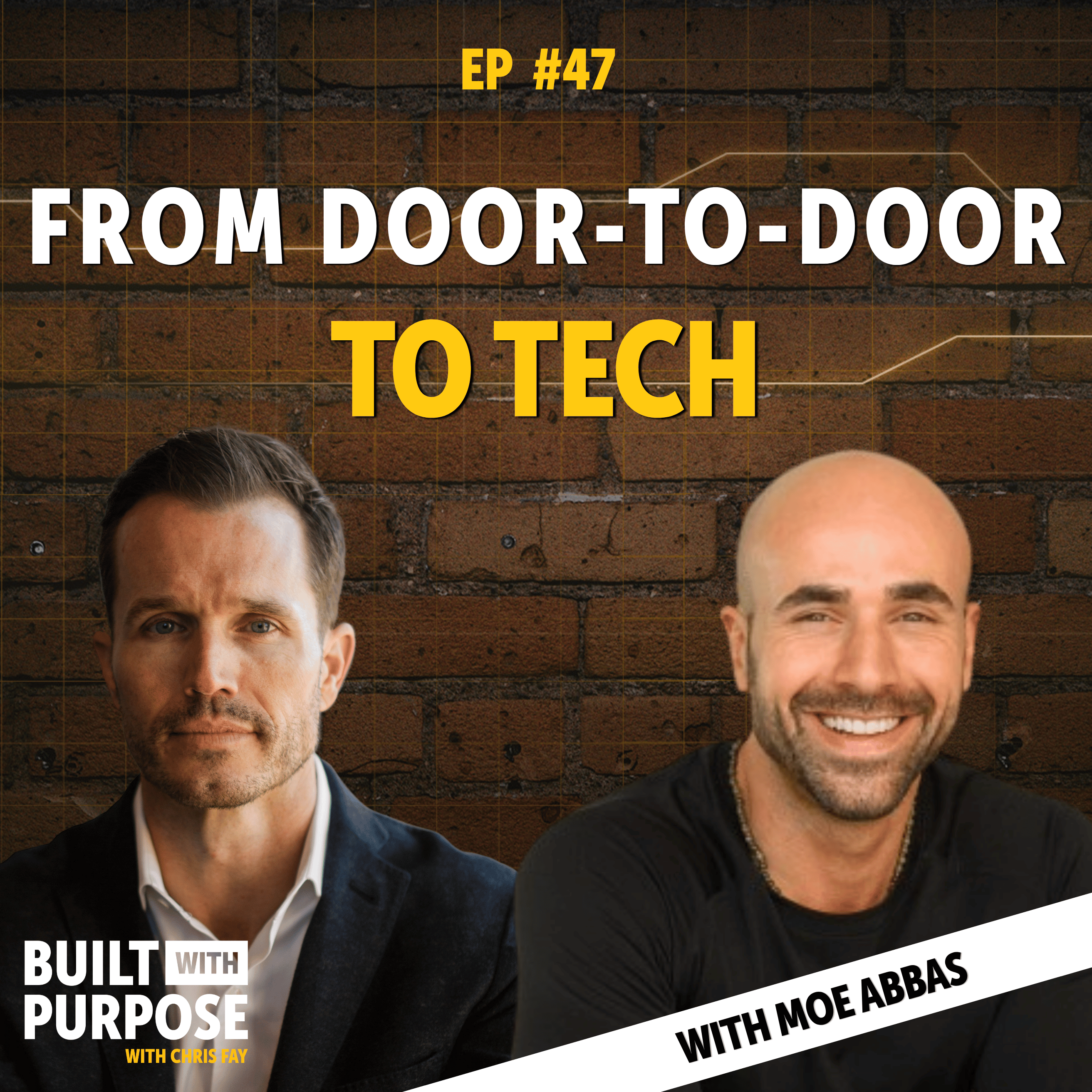


In this candid episode of Built With Purpose, Chris Fay sits down with Moe Abbas — founder and CEO of SalesAsk — for a conversation about immigrant grit, the true cost of entrepreneurial sacrifice, building and rebuilding companies through failure, and how AI is transforming the way home service and construction businesses sell.
Moe shares his journey from Lebanon, where his family fled a war-torn country when he was three, to a working-class upbringing in Canada raised largely by his mother while his father worked seven days a week as a tiler. Left with unusual freedom as a kid, Moe started selling door to door — lawn care, chocolates — and discovered an early talent for sales. A pivotal moment in high school, getting beaten up and then dumped by the girl he'd chased for years, sent him into two and a half years of self-transformation: daily workouts modeled after Arnold Schwarzenegger and six to eight hours a day reading nonfiction in a bookstore. That foundation carried him into a job fixing phone lines he didn't know how to fix, first in British Columbia and then in Palm Beach, Florida, where meeting wealthy homeowners taught him a lesson that reshaped his ambitions: they weren't fundamentally different from him.
Chris and Moe trace the arc from there — building and scaling a residential design-build construction company across Canada with a crew of childhood friends, a cash-flow innovation that changed the business's trajectory, and running multiple companies at once, some hits and many duds. They dig into the decision that changed everything: walking away from a thriving construction business to chase a bigger game in technology, a bet that cost Moe his marriage and led to a failed social media startup that burned through his savings. He talks candidly about the discipline it took to climb back — running a construction company for three months to stabilize it before handing it to a partner, building a second startup to modest success while getting rejected by Y Combinator eight times, and learning the difference between tenacity that pays off and stubbornness that just delays the inevitable pivot.
The conversation turns to SalesAsk, the AI sales platform Moe built for home builders, roofers, and home improvement contractors after spotting a competitor's rapid growth and betting he could build a better product. SalesAsk listens in on the sales conversations that happen at the kitchen table, scoring reps and generating coaching and follow-ups synced to CRMs.
Chris and Moe discuss:
- Growing up the son of a tradesman working for a "slumlord" landlord, and what that taught him about opportunity
- How getting beaten up and dumped in the same 24 hours became the turning point of his life
- Two and a half years spent reading in a bookstore instead of going to college
- Fixing phone lines in Palm Beach mansions without knowing how to fix phone lines
Key Takeaways
- You can't manufacture a market — you can only shift your product to fit one that already exists
- Entrepreneurship is a game of pain tolerance more than anything else
- The cost of chasing a bigger vision is real, and rarely talked about honestly
- Winning and losing at home and in business are reflections of each other
- Concentrate to build wealth; diversify to protect what you've built
Connect with Chris & Moe
Chris Fay — LinkedIn: /cjfay
Moe Abbas — Founder & CEO, SalesAsk — Website: salesask.com
Chris Fay: Welcome to Built with Purpose. I am Chris Fay, and this is the show where vision meets execution and leadership leaves a legacy. From design studios to innovation hubs and product lines to skyline. We meet the people building more than great companies. They're creating culture, driving impact, and shaping what's next. These are the stories and strategies behind how the world gets built with purpose. All right, everybody, welcome to Built with Purpose. â I'm your host, Chris Bay. I'm in a different setting today because I'm actually working from the house, and so you get to experience my wife's â red room in the back. I am really excited to â Mo Abbas to our â our show today. He is the founder and CEO of Sales Ask. Mo, welcome to the show, brother. Excited to talk to you, my friend. Like West Chris, excited to be here. Yeah. Well, we talked it's â so we're we're pre recording a little bit. So it's a it's a Friday afternoon, you know, we're kinda getting ready for the weekend. What you what you got going on this weekend? I actually have a friend in town and â he really wants to go see the Mirror Woods. So I'm gonna give him a little bike tour of San Francisco and then take him up to the â the ancient Redwoods. Awesome. Man, it's been a couple of years since I've been there, but â it's a it's an awesome, awesome experience. We used to always come into San Francisco and then kind of on on way up to â Napa Valley, we used to have couple of meetings up there and we would always kind of pit stop and â and see the trees. So it's a really cool experience. Yeah, California's just got, you know, very beautiful, unique landscape. And if you ever get a chance to come here, you definitely gotta see the Redwoods. It's the only place in the world that has them. It's awesome. So my one of my friends that lives in South Carolina where where I live currently, in front of his yard, he bought a house from a guy that had had had had â planted, transplanted a redwood, a baby redwood to the front yard of his house. And so you've got this like, you know, southern house with â pines and oaks and all the things. Then you have this one, probably I would say now thirty five year old redwood sitting in the front lawn of his house. I didn't even know you're allowed to touch redwoods, â yet alone transplant them. So that that's interesting. I mean, I do see them in some of the houses here where You have this like little tiny cottage looking bungalow and this two hundred skyscraping redwood in front of it. And it's like it's super weird, but really really it's like the house is lifting a little bit too in front of the in front of the redwood. Yeah, it's one of the ones you don't want it to grow really tall and then fall, 'cause I'm sure it's gonna take a lot a lot â a lot with it. So â well, so so first off Picked up on the accent. I've done some homework and research on you. So you've originated from Canada, if I'm not mistaken. Yeah, I grew up in Canada. So you're probably getting the Canadian accent. I mean, I originally came from Lebanon. my family emigrated to Canada when we were three years old, but I grew up in Canada. So I consider myself very much Canadian. I actually recently moved to the United States, â up in, you know, San Francisco Bay area. And yeah, so but yeah, you got you got that accent right. So what â so I'm I'm curious. So the move, what's been your â first impression of actually living in the â in the US? I mean, was it different from what you expected? I'm sure you'd obviously been here before and traveled here, but now you like you you kind of uprooted and moved to the US. What what was your first impression and how does it compare to â to what you expected? My first impression was ten, eleven years ago when I came down here â with the MBA program at Ottawa University â as a guest. And we did a tour of the valley. And it it was remarkable. It was, it was like nothing I've ever experienced before as an entrepreneur. â it is the mecca of entrepreneurship. You have the smartest, most talented people in the world here. And you'll feel that as soon as you come to the city and start interacting with people. so that that that was my initial impression. Ten years ago, I said after that trip and you just realizing that this is the place to be if you want to be a top rated entrepreneur, mostly in tech. â I said, I'm I'm we're gonna move to California, to San Francisco, to the Bay Area, Silicon Valley. â I I I told my family, we're gonna give me one year, you know, and we're gonna be in in in in California. It's it's been ten years now. So it took it took a little longer than expected to to convince to convince them to move. I said I said, hold my coffee. You know, it's just by the time that's cold, it's things evaporated now and like so Yeah, yeah. â I'm sure. Yeah, it it's it's taken a long time. There's a reason why I'm here. I think the US is the greatest country on earth. I think this is the greatest place for entrepreneurship you can possibly go to â for many reasons. â and that's that's why I'm here. Awesome, man. What's that's super exciting. Yeah, it was funny. So I start I started my company. on the east coast, right? And so there was a lot of conversations about can you build a successful, you know, technology business on the East Coast, separate from there. And so it's been interesting. We haven't we haven't failed yet, but â it's definitely I've been out there a good bit, have a lot of peers and friends and and partners kind of in that area. So â beautiful, beautiful part of the country. â well give give us Mo Mo give us a little bit, I mean, you you've got a really interesting story and I'm I'm curious even tracing back kind of to to Lebanon, but kind of walk us through you You know, Lebanon, you moved to the to Canada for, you know, when you were three, you know, what was that like? And then obviously we'll kind of get into your current company today, sales ask and what you all are doing. But kind of give us the thirty thousand foot view of â who you are, man. Yeah, I don't remember a lot about Lebanon. I only remember on the plane there was a really kind gentleman that gave me a piece of this cake. That's my entire memory of that tri of coming into Canada. â which was a good one at that point. â And you know, we left Lebanon because it's a war-torn country, gets blown up every couple of years by one one of our neighbors. So finally came to Lebanon, it's all great. â no English, no education. And it was really hard for my parents, â especially my father, who really only had very basic skill sets, you know, didn't even graduate grade school. And he he would be working a lot. as a â as a tradesman as a tyrant â doing handyman work for this landlord lady who was you know she she was your classic slum lord where she was extremely wealthy this Indian lady and â extremely frugal and cheap okay and she owned hundreds eventually thousands of low rent units low income low rent units And my dad was her go to guy to essentially do the work in those units. He didn't speak any English, so she would obviously get great deals and you know, fix them up, rent them higher, make money, move on to the next. She became fabulously wealthy. And he did that all throughout my childhood. I actually didn't see my father very much raised by mostly my mother. We were five boys, â four boys, one girl, five children. She was super busy, you know, with very low income, trying to keep all of us going, let's say. And so I had a lot of freedom, right? Because my parents were occupied. My father really wasn't there very often. He was working seven days a week. And then my mother had five kids, no money. So she had to do everything herself. â so I, you know, for me as as a as a young child, I would wander the neighborhood, I was very curious. you know, pretty much complete freedom. Kids don't have this anymore. Okay. Like I I have a â 13 and 15 year old wife, okay. And well now I'm I give them a lot of freedom, but you know, I just now you can't go a hundred meters from your house without you can't even leave the vision of your parents until you're a teenager a lot of the times, right? So back then it was a different time. â I'm not that old, but it you know kind of feels like I am. And so we we'd go around explore spoilers different neighborhoods. That was kind of the baseline of really opening up my curiosity and You know, eventually I would just knock on doors and talk to people. And then, you know, grew up very, very poor. So I figure, hey man, let me go try to sell people some stuff, whether it was, you know, lawn care, whether it was chocolate. And I got really, really good at that. â you know, I remember coming home with like a hundred dollars and as a twelve year old kid. From selling chocolates door to door. And and that was that was a lot of money, man. That was like a huge amount of money. I didn't get to keep any of it. Yeah. Which was right. Hand it over to your parents, I'm sure. Your mom had to support. But she'll pay you your wages of two dollars and then, you know, get on with your day. And that's what it was. Yep. â but that was great. It it taught you a lot. You know, I I think going door to door is something that if you're doing sales, it's one of the critical It's just an easy way to get reps. It's really hard to get reps in sales. That's one of the best ways to get reps and rejection and go to the next store and go to the next store. And that gave me the foundation from one of my core competencies, which is sales. Right. I've been in that game now for 30 years of just sales since I was around ten years old. So I'm 40 now. â you know, and and and I did that. And I I didn't graduate high school. Okay. So in instead of I wasn't very good at school. I didn't believe in the school systems. I didn't go to university or college. â when my friends went to college or university, instead what I did is I just started a business. Okay. But before I did that, I did get educated. â something happened in high school where, you know, there's there's these moments in life that create instant changes in you. They usually have something to do with the you gotta suffer ultimately. Could be health. Could be heartbreak. In my case, the girl I was trying to see all of high school eventually she gave me a chance. Something happened, some stupid shit. She dumped me. I got beat pretty much I got beat up and then she dumped me the next day. â yeah, yeah, yeah. So your ass. You get your ass kicked and dumped, man. That's those are two â those are two tough things in a row. Yeah, but that that probably the most consec one of the most consequential things that's ever happened to me. Because of that, I mean this is like day one, day two, and you I gotta see this guy the next day in school, by the way. Okay. â and it wasn't just beat up, it was like gang beat up. â and it was really embarrassing. And then, you know, she dumps you the next day after spending three years or four years of your life trying to chase a girl and finally getting her. â so I I I kinda I had it, let's say. I I was done. I didn't care about anything except never being in that position again. Okay. I never it n and then I I did a lot of self-reflection after that. And then I'm like, â I was overweight. I was broke. What am I doing? I was smoking one weed. I still still smoke weed after that. But, you know, I was in this position of my life that didn't reflect the image I had of myself. And that was a moment to really look at my life and be like, this is not who I want to be. I don't want to be a guy That gets gang beat up and then ducked. Okay, well, who do you want to be? And I started looking around and I found Arnold Schwarzenegger. So he became my role model when I was 16 years old. So I started working out, going to the gym every day. And I became super fit, like extremely fit. â so completely transformed my body. Anybody that's trying to do a transformation, it's always easy to start with your body. Because and I tell people this, if you can't control yourself. Where you have total control of all the variables. What the hell could you do in the in the world? Right? So go start with yourself. Start physically. Cause it's just you and the weight. Forget about you trying to sell someone and hire someone and depending on a rep or depending on an ops or depending on a build or whatever it may be. Okay, or a contractor. It's just you, buddy. So â you know, that was how I got super fitted. And then for education, I would go to the bookstore. I was already like a big reader, but it was fiction. So I switched to reading nonfiction and I would I would â roll a blade to the bookstore and I would spend six to eight hours every single day for almost about two years or so, two and a half years in the bookstore reading. Okay. So and I would read like a book every day or so. I'd write a book practically on every shelf in the bookstore. So, you know, not just business, not just self help, you know, physics, just to get a broad understanding of the world. And that was my life for a period of time. Eventually I got some you know, when you're fit and you're attractive and you're intelligent, people want to do business with you. That's right. So opportunities for sure. Yeah. Somebody I went to school with, he's like, I saw him in a parking lot, came up to me, like, hey man, what are you working on these days? Like, you should come check out this opportunity. Two weeks later, I was fixing phone lines in British Columbia when I was seventeen years old. And then not long after that, I became a technician, phone technician when I was 18 years old, up in â near the Miami Beach area. Okay, so I'm 18 years old. I actually don't know how to fix phone lines, just to be clear on this. I had no idea how to fix phone lines. The only thing I knew how to do was talk to people. And I had a great energy, right? Like, you know, you're young, you're fit, you're you're good looking at the time. I don't know. That's still a thing, but I lost my hair. I used have hair back then, you know. So it was a different time. Yeah, my my my for my forehead keeps getting bigger. I'm a little bit older than you are, but not not not by much. And I watch I watch the â I watch the forehead. I'm like, bro, I'm gonna hang on to this hair as long as I can You're good, buddy. You're you're your goal. That's like my dream, man. Yeah, right, right, right. â man. So I go to Miami and that was eye opening for me, okay? 'Cause I'm eighteen years old. I'm the youngest phone technician in the country. Don't know to fix phone lines. And I'm making five hundred to a thousand dollars a day. Huge amount of money. But that wasn't the interesting part. The interesting part was I'm knocking on these doors up in Palm Beach. And I'm, you know, I'm waiting and I'm waiting and I'm waiting. First, I gotta go through the gated community, which I've never seen a gated community before. Like, â wow, there's some really fancy stuff here. And then I go into this giant house and with the yacht in the backyard, and I'm knocking. And you gotta wait a couple of minutes 'cause the house is so big the person's gotta walk like five minutes to get to the door. Finally they get to the door and it's just you it's like a sixty year old man. And he's frail, it's interesting, you know, sharp minded, but not wasn't you know, I've never seen wealth in my life. So I'm thinking you know, John Travolta's gonna come up with the door. It's a whole nother whole nother level, right? I'm just imagining like, you know, a celebrity is gonna come open the door, right? It's gonna be Brad Pitt. Yeah, this Brad Brad Pitt lives here for sure, you know. So I'm getting my autograph book out, you know, and I'm like, no, no, it's â it's an old man. And we start chatting. And of course I don't know how to fix phone lines. So I'm like, I'm gonna go check. I check, but I come, I'm like, look, I don't know what problem is. And then we start talking, they tell me their story, I ask questions, and I learn about them. So to me it was an education about who these people are. And what I walked away with was They're not any different than me. This this person's not bleeds the same blood, right? They they they they are not better. They are just wealthy for you know, obviously you realize why they're wealthy later on. And then that really shifted my mind on wealth and what I could become. Because I was like, hey, I could be wealthy. If they can be wealthy, I can be wealthy. I see it now. It's not. a con you know up until that point the furthest I've gone was that BC and then and then like four hours outside of my hometown. Right. Yeah and you probably just you probably just project that you know there's a there's this whole other class out there and they have something that I don't and it's a separate â they've got different opportunities. But then you realize like look they're just they're just guys and girls just like me. They just have done something different with their life, you know, whether it be different opportunities or different â different pursuits, but â just people, you know what I mean? That's another lesson where, you know, I I tell people this, like it's like you can get a lot from books, okay? I got a lot of inspiration from books. But there's nothing like travel. There's nothing like putting your eyes on the thing that you want somehow, right? And I I I couldn't even imagine that where I well from my position, even in a book. It's like somebody who's never seen an ocean. Live in the desert their whole life. They can kind of read about an ocean. It's not the same as being on the ocean, right? Right. Right. So So I come back to Ottawa. I got some money. Of course, my parents take their tax. They have to fix their furnace. So I paid for, you know, to fix the furnace. And it is what it is. it's an immigrant tax, is what it is. The parent tax. Immigrant tax. Yeah, yeah. Are you are your parents still are they still in Ottawa? They are still in Ottawa, yeah, yeah. Are you still paying tax? That's my c â question. Of course. Of course. I pay all their tax now. Taxes only get bigger, well, it's like socialism. Become a socialist country now. No, it's it doesn't make sense to make money if your family is suffering. It's just a foreign concept to me. â the only the challenge with my parents is they never evolved from when they landed in c in Canada, right? So they're exactly the same. They haven't gotten any more educated. They haven't really learned any new skills. Right. They've kind of raised the children to be good human beings and and then just are kind of waiting to die almost. Right. So they're not really healthy. They're kind of what you don't want to be. So I look there's there's a lot of lessons I learned from my parents. Like they're both sick. They're both not healthy. and you know my dad's 65, my mom is â late 50s. And I have friends and I know people in that age range that are living life maximally, right? And like going to the gym and like and fit. And it it's just and then I see my parents and you know, they really inspired me to pay attention to my health. You know, at the time, this is different. When you get older, you can lose your fitness. But after seeing them, I'm just like, yo, I I need to â I you know, health is just huge, huge part. Just don't do what they do a lot in a lot of ways. Right. So there's there's role models and then there's anti-role models. Yeah, no, it's I and it's funny. My my wife and I are going through this right now because our our parents are in their, you know, mid to late seventies and you're you're watching and witnessing how each of the parents are looking at like this last this you know, this this these last number of years that they have, whether it's 10, 20, you know, whatever the number is, and how they're treating their bodies and how they're thinking about this. And you know, we've got some that are that are very proactive about being healthy and eating right and participating in the kids' life. I've got two boys just like you, 15 and 17. And so, you know, hyper proactive about engagement. And then and then others that are just kind of the exact opposite, you know, or are not taking care of themselves, not trying to improve. And I think that's one of the things that that my wife and I have talked a lot about is, you know, to your point, you can have amazing role models on what to do and then also amazing role models on what not to do. And then ultimately it's up to us. It's it's our decision on what we do with that information and how we and how we handle that in in our life. So and I honestly, man, I think, you know, it if you know, I think it's good to see both sides. I mean, I think it's good for us as humans to see, you know, the good, the bad and and and the ugly. And I I remember early on when I was â you know, early in my career, you know, so somebody told me they're like, Look, man, you you obviously surrounding yourself with great people is one of the best things that you can do. And you're gonna take, you know, little snippets from each person. You know, but also, you know, being around individuals that you don't want to be like is is sometimes equally as impactful as being around the ones that you want to learn from, right? 'Cause it just really helps to shape you. So no, I get it, man. I'm you you and I are singing the same sheet of music there. Yeah. I saw this this funny meme where it was look, fifty year olds these days they either look like they're thirty-five and you it's hard to tell what age they are. Or they look like they're like sixty five years old, been smoking their whole eyes. Right. Right. Right. Where where are you gonna land? Where are you gonna I Yeah. And that's a whole other conversation about health. But one thing I did know is that it's gonna take me a very, very long time to create the level of wealth that â well at first I didn't know that actually. When I hit thirty I realized that, but in my twenties I thought it would be like an overnight thing. When I reach thirty I said, Fuck, this is gonna take way longer than I thought it would. Yeah, it's right. It's a little bit Little bit harder than I thought. Yeah, like I'm not talking like a million bucks, like we're trying to make some big wealth here. And you don't want to be old. I don't wanna be old and wealthy. So you gotta take care of your body and your mind so that, you know, when you do get into that position, you're not rich and old and you've given up your whole life to make money, which also sucks, right? So Yeah. Yeah. So I came back â yeah. Yeah. Yeah, I came back to Canada and then I started a door to door company. Doing lawn care and fixing driveways. Sold those two companies and started my first construction company. Okay. Now we're getting to the design build world. Now, again, I had no experience in construction. My friend was working at a gym and he's Hey, he calls me up one day. He's like, Hey Mo, doesn't you die? Isn't he like a handyman? I'm Yeah, he's a handyman. He's like, â okay, because we're looking to do this commercial fit up of this gym. And â I know the the guy making the decision. I can help you get the contract. I'm like, yeah, let me get that contract. So it was like big contract. So I got the contract. â I bid like I think like five hundred K and I got it. I was like, wow, that's like a huge amount of money and it's only gonna cost me three hundred K or three hundred and fifty. That was a two that should have been a two million dollar bid, by the way. â obviously I had no idea what I was doing. I didn't even bid, I just gave the guy like a one little like if now it's like when you see the guy, I was Clearly he knew that I was under bidding this massively, right? Yeah. Hey, but you you got it though, man. It's a it's a found it's a foundation. It's one of those pieces in your story. Well, I got it. Yeah, I got my ass kicked is what it was. So Yeah, yeah. I got â I got this contract. It's to to renovate this gym. Now, look, I don't know how to read plans, I don't know what gypsum is, I don't have a network. I had like sixty K I'd saved up from my previous work that I was doing. â and I used it to fund this project. And I lost all of it, frankly, â to fund this project. And you know, I remember there's a few key moments in that project where I'm like engineering a floor. Okay. Like I'm there trying to figure out how to structurally build a floor. Again, no schooling, don't know how to read plans, just looking at it and putting the studs in the concrete. And obviously that wasn't, you know, it wasn't a good job at the end of the day. making some really stupid mistakes. â but that was that was interesting. And then I remember, and this was a kind of like a breaking moment for me where it's like 2 a.m. The place is pitch black. There's no lights. You know, I'm demolishing this like 12 foot tall cinder block wall. It's dust everywhere. My hands are bleeding. I'm by myself. It's like wow, this is painful. What am I doing with my life? Right. And it was like one of those moments where I realized that This isn't there's gotta be a better way. So, and there was a better way. So I shifted to focusing on residential. Because residential is you can talk to the client, there's smaller contracts, you can risk manage, you can sell. Okay. So I use my salesmanship and I could figure out the problems are easier. You can deal with the customer, you're gonna get paid, right? Because you can talk to the person. So I did that. â I did a million dollars for Starbucks. In my first year. Okay, just me meeting customers, posting on classified ads. â I'd meet them and like, you know, I gave them a good price, but they trusted me right at the end of the day. And then I moved to at that time frame, all of my friends were starting to graduate university. And they, of course, they had no idea what they were gonna do with their lives. â meanwhile, I had this company that I just started and is growing very quickly using I also figured out marketing at that point. So SEO was a new thing. I jumped on it very quickly. I used SEO to get a lot of leads and I used my salesmanship to close those leads. Still don't know how to anything I still don't know very much about the trades at that time. Right. I'm like about twenty years old at that. â so I hire my friends. We start off and you you got you got you got buddies that you can bring in and let them worry about figuring out How to build everything, right? I mean it's like the line bleed the blind bleeding the blind, right? Ain't nobody knew anything, I'll tell you that. You know? â and they're they're all like commissioned too at the start. I'm like, I'm not paying you guys, you gotta you like I'll pay you commission to start. Maybe let us grow the company. So you know, it it was awesome because it was a twelve of us at one point. And we're all childhood friends, like a dozen of us, right? That's cool, yeah. â out of this basement office and it was We had no space. I was working out of the closet. We kept hiring. We kept growing. We're like doubling. We went to like five million. And then we started opening up. Well, and then what I did is, and I think everybody should do this, is I looked at the market and there was one big leader. And that leader was doing design build. And design build is a new concept at that time. It didn't exist in residential. Right? So I was like, wow, that's really smart. â For a lot of reasons. Number one, you can secure your build pipeline. Now you know what builds are coming in because they're in the design. Because you know, RBC cash flow management's a huge risk in the in the in the design build industry. I was I'd run out of cash all the time. The other big innovation that allowed us to really fund the growth of the company was very small little shift in the contract, where instead of collecting at the end of a milestone, so you have to fund the projects. You collect at the start of the milestone. All of a sudden, we went from like, you know, I'm like, the company's done. We we don't have enough to meet payroll. We have 200 grand, we owe 400 grand, and all this money in like a month. Like I'm we we got a month, we're done. And then I'm like, wait, wait, no, let's let's let's do this change. Let's tell all the new customers, hey, we're not we can't fund your project, we're not a bank over here, right? So if you want us to secure this for you. You pay at the start of the milestone, we do the work, â you know, and then we fund the next stage. And then the last ten percent is a holdback. Okay. Right. Yep. Now you're funding it, right? Yeah, exactly. Right. You're like, okay, now I more money in the bank. I I have 400, I owe 200. So now we're in better shape. Immediately your cash position changes. Right. And it's it's it's reasonable. Nobody was doing that at the time. â so all of a sudden our cash is like, thank God. Now not only can you Fund the company, you have actually excess cash. And you got to be careful because obviously these are client deposits at the end of the day. Like, you know, there's a risk involved in that. â but we started growing the organization, and there's a there's a lot of lessons there. you know, this is a construction company. How many people you know have scaled a residential design build company? You can count them on two hands max in the whole North America, right? So we scaled it across the country. â and you know sold hundreds of millions into the home. that was amazing. Very magical moment of my life. â but then there was a point where I'm like, okay, you know, it's also really hard. If you you know you're building a design build company. Hustling hard man, yeah. Yeah, and we know I I was inexperienced. I didn't have like it's just me figuring everything out. And you are constantly dealing with problems. Whether it's people problem or project problems or money problems, right? And I I'd overstretch myself because not only did I start these companies, I also started another commercial company, and then a foundation company, and then a plumbing company, and then a marketing company. So I had this this this freaking mess where, you know, mind you, some were hits, but most were duds. Nobody's gonna succeed in all their shots. But the duds were draining, right? So there's a lot of problems to deal with. And there was a point where, you know, I kind of reached the top of what I was going to reach. And then it was just going to be a very long game to get to, you know, a hundred million from where I was at the time. or more. And other you know, I could dedicate the next ten, twenty years of my life to this. And It'll be a good outcome. Okay. It's gonna be a good outcome. Yeah. I'm already like doing pretty well, making money. But this is my life. Like, you know, what are the the cost I paid to become the entrepreneur that I am is tremendous. So why am I not playing the most valuable game I can play? Which You know what, you gotta understand again, I I didn't come from an educated background. I had no network. So I didn't even know that there was the business of software, technology. I didn't know it existed. Not all games are equal. Okay. In construction, you grow linear a lot of the time. Like some people have figured it out. You can do like private equity roll-ups. â you can scale, you know, maybe like an HVAC company. Pretty much HVAC's the only one that's really figured this out well. â maybe a few other niches are trying to do it, but they're pretty much linear growth. And I tell you, that's that's been amazing just over the past couple of years, seeing the HVAC companies. I mean, even just here in our local hometown, pretty much every HVAC company, you see them following the exact same playbook, take on PE, rebrand on marketing, pricing structure. It's been amazing to see what PE's done to that space. Yeah, they're trying to do this through roofing now. It's a bit more challenging to do, but I think, you know, they'll figure it out. â and and there's not a lot of places you can do it. I mean, HVAC roofing are good ones. â yeah, because you know, I I deal with with these people, right? Every day, hundreds, thousands of them. Of these business owners with sales ask. â so anyways, I made the decision to build a technology company. Okay. Which was the one again, one of the most d challenging decisions I've ever made in my life. Cost me my marriage, which I don't know if it was worth that cost, let's say. but that's the cost I had to pay. Because, you know, I was I was the top dog in construction. You know, my family could have everything they wanted. And I said, I want to do something big. I want to see how far I as an entrepreneur can go. Right? I want to you know, I wanna go to the NBA. I wan I wanna become one of the greatest players. I don't just want to play basketball. Right. And then my wife said, We have a great relationship. She actually came down to California with my kids when when we moved down. â but that time frame was so hard because she didn't get it. We had just had a second child, and â I'm like I'm gonna go start the startup. The startup look, if you know nobody's except for a few people that come from A certain pedigree in the valley, it's extremely difficult to nail your first technology company. Okay. Extremely difficult. So I thought it was gonna be a walk in the park. I'm like, I'm the top dog here, I'll be the top dog there. It's like this can't be as hard as construction. It's not. Right. Just figure this thing out, right? It's just it's just software. That's all you have to do, right? You know? â I'm only gonna go as much. Yeah, it's just one product. Well, no, it's funny, and you as you as you're sitting there, I think about like word sacrifice because I think that, you know, I I've I've reflected back on this a lot in in my life and kind of the journeys of, you know, taking over a company, starting companies, and, you know, just all the changes and ultimately, you know, the sacrifice that it takes to really get do something great. You know, that and you look at some of the people that have done some of the most amazing things in the world and you're like, you know, I don't think we oftentimes appreciate the level of sacrifice that they've put in to create those, you know, global world changing organization. And honestly, for me, it's been something that I've I've battled with internally. Cause I, you know, I've you know, my wife and my kids are kind of the center of my universe. And so I want to pursue, you know, one route of of growth and success. And by the same token, I want to make sure there's that balance there. And so, you know, how can I do both? One's gonna have to give over the other. And so I think that's something every entrepreneur â struggles with, you know, and I don't think it's something that we talk about enough. And I think certainly people, if you've not been in that seat, â you certainly don't appreciate, you know, the the the sleepless nights, the continuous hours of work, the stress, you know, the the the the chest pains that you're dealing with as you're making key decisions about people or finances and figuring out where you're gonna go. I mean, the struggle is real, man. You know, I think a lot of people that are that are have not ever experienced that just look and be like, â if they they started a company and they've been successful and they make money and you know, â my gosh, like look at them. But the You know, the level of sacrifice to get there has been has been tremendous. And and I even see it with my with my kids. You know, I've got, you know, I talk about two boys, football, the cross players, and they you know, we we very specifically talked about do you want to go to the next level with athletics? And in order to get to the next level with athletics, there's a level of sacrifice that you have to put in place today. Are you willing to sacrifice what it's going to take today in order to get to that next step? And I've had one son say yes. And I've had one son say no. He's like, no, I I don't wanna, I don't wanna sacrifice that in order to get to the next level because I want to enjoy my my time. So it's you know, kind of making that conscious decision going in. Are you willing to make the appropriate sacrifice to really achieve what you want? â brilliant. She taught me. I'm sitting here like reflecting back on all the things in my life as you're sitting here talking. So it's good. This is a it's a good mental moment for me as well. Yeah, I â Elon Musk is like, yeah, entrepreneurship is like chewing glass and staring into the abyss. right? And like the the sacrifice is inevitable. And you know, the game of entrepreneurship is a game of pain tolerance. Okay, it's literally all it is. It could be extremely boring as well. It's the complete opposite sometimes, where I, you know, sometimes my companies by the way, it gets it gets easier and it gets better as you get more experienced. Okay. Yeah. And you have more money and resources. You could hire people, you could do more of what you want and more of what you love, et cetera. you know, so now it's it's way easier for me, right? But now I'm conditioned too. Like I I have the experience. I know typically what's a good decision, what's a bad decision. You know, what used to take me twenty hours of deliberating, I can do it in two seconds, right? That's the right way to go. Right. Something I don't like doing, I could hire. I have resources for this now. Right. â this even the struggles that my wife, you know, was going through, I could hire now and solve those problems ahead of time and help her in ways that back then I didn't have the right, you know, situations for that, let's say. So it does get easier and easier. And then now I also have many companies. So the risk is diversified. I've also learned to di you know. Look, there you're Andrew Carnegie says, hey, you want to build wealth, put all your eggs in one basket and watch it very closely. And then you get somebody like â some of the great entrepreneurs investors that say, you know, whether it's Warren Buffett or â principals, what's it? Ray Dalio, who's says, you know, it's his whole strategy is diversification. So look, at the end of the day, diversification is a risk management, but it's not the way to make wealth. If you want to make wealth, it's concentration, right? That's right. So you gotta go in and out between the two. You should concentrate when the on the one thing that could be your big amplifier and diversify enough so that if you know if you fail somewhere, your family is not dead. You gotta protect your family, right? At the end of the day. It is a top priority as a man. I don't know. I may maybe people don't talk about the suffering enough, but yeah, i i there's a certain level of you need you need time, you need money, and you need you need the experience to build a company. â but really what it comes down to is just two things. And I I can talk about, you know, a technology company and my first one was a complete failure. I had to sell all my property to fund it. And I had no idea what product market fit was. That's a key concept when you build a technology company. I didn't know what it was. I didn't know what founder market fit was as well. Right. So I built a social media app. It was started getting a bit of a reality, like this could work. Dump all the capital into it. I'm gonna be the next Mark Zuckerberg, burn, you know, over a million dollars, had to sell property. I left my construction companies. Of course, I was the key driver. They started failing. So failing construction, sold all your property, failing in in the tech. Wife, second child at home. Go back home, nightmare at home. Right. And then I'm like, losing a business. Of course you lose when you lose at home, you're losing business, by the way. They are a reflection of each other. Sure. You lose everywhere. Winners win, losers lose, right? So there was a losing period of my life. But there's one thing that entrepreneurs, the great ones, have. Okay? And it's one of the virtues. So I have seven virtues. This is this is one of them. Tenacity. Don't stop playing the game. Just just don't stop. Don't die. The key concept is don't die. Right? So. Just like, â ooh, â almost dead, almost dead, dodge, dodge, dodge, dodge. I had to kill a few things off, you know, and then concentrate on my my cash flow, which was one of my construction companies. I actually left technology to go back into construction for three months to clean up a bunch of projects because the one of my â the partner that I was putting in the company and I gave him a large piece of the company to run it. Okay. And didn't buy in, just gave it to him. Just run this, save me the headache. I trust you. He's like, I'm not clean, I'm not running your your shit show over here. Go clean your projects up and then I'll run from a better. And I did that. And that was really hard to do. So I was like running both at the same time. Left it. He now turned that organization. They're gonna do 30 to 40 million dollars. Okay. â and I gave it to him and it was like six, seven million dollars. That's awesome. Yeah, hell yeah. All right. Right. He's printing cash for, you know. And there's people that have been in that company for twenty years. My sister works in that company. He's one of my best friends. One of my other good friends works in the company as well. Right. So it's just â it's a bit of like a an heirloom at this point, that company. â and it it print like it's a cash cow, right? The end of the day. And then okay. That's first startup failed. Forget about it. Pivot. We're gonna move on. We're gonna build another one. Another one is a modest success. It's the number one place for marketers come to launch recovery. It's a completely different market. It was a bit more in line with my own experience. That one was also really hard. â you know what Y Combinator is? Yeah. Eight times I applied to Y Combinator. Eight times. Eight times, yeah. And one time they even flew me down. Okay. Never got in, motherfuckers. â but â motherfuckers. It's okay, it's okay. Hey dude, you know what? I this is this is the exact same thing I tell my I tell my boys, because they you know they expect everything to go right. And I'm like, look, bro, I'm like sometimes you can just get you're gonna get kicked in the teeth, and everybody's gotta get kicked in the teeth and pick yourself back up, and it just gives you that drive and that tenacity. And I think that's to your point, as you think about like entrepreneurship or just really anybody that's trying to be successful, is like, you know, the the percentage of people that give up. When times get tough as pr as a percentage of the people that really push through and continue to just never give up and fight and claw, eventually doing those things, you have a higher propensity to finding success in that regard. But, you know, I would say a large majority of individuals are just not willing to push through the shitstorm, you know, the getting kicked in the teeth. I'm gonna I'm gonna I'm gonna elaborate on that for just two seconds. Number one is you you it's not you may get kicked in the teeth, it's how many kicks can you handle. That's right. Right, before you have somebody but like I'm I'm so there's there's a mistake that I've made in the past where I was tenacious when I should not have been. Okay. Where I didn't give up, but I should have given up, not on being entrepreneur, but on that idea where it was like clearly not gonna work. But I'm like, no, we're gonna figure out how it's gonna work and this and that. I'm just like, so there's a key lesson is you can't solve market. problems. If there's no market, you will never be able to solve that. Okay. No. You can't make a market happen. So you can shift the product to a market, you can't make a market, right? At the end of the day. So there are there is a scenario where, you know, â Mark Andreessen says strong opinions loosely held, where like I had a I I should have shifted out of the first one way quicker. I was too tenacious in a way. The second one also I should have shifted out quicker because you know, good is the enemy great. That second startup, the tech one, was it was good. And it was almost could almost like you know, you're doing like two million in revenue, but you just can't get past two million because your churn, which is the ret the clients that you retain, â were not was not was not was wasn't very good. The business model itself was flawed. I had to pivot the business model. I was not willing to do that. I just kept trying to solve other problems. If I shifted the business model, it's kind of like a big pivot at that point. And then I kept going for probably two years longer than I should have, because it was good. And then I said, look, this is not gonna get me where I need to get to. I gotta build another company. At that time, AI came out. I actually was looking before GPT 3.5. And GPT 3.5 was the real breakthrough moment in the AI. Where the LLMs could, you know, they're they're excellent. They have excellent outputs. Not excellent, but very good. And you can kind of see where that's going. You see where it's going, sure. So we decided, okay, I'm gonna build on the company. I searched, GPT five come out, great. And my my friend â you know, the origin story of sales, everyone I think came comes up with both bullshit origin stories, I think, to be honest. â I think they're all kind of I can I can be like, â yeah, it was like a problem, my partner gave it to me and it was AI came out. No, what really happened. Was a friend of mine went to a conference and he came back and he's like, No, I saw this company at a conference. Okay, it's it's a company, â I won't name them for now, but and he's like, They went from one million to ten million in one year, and pretty interesting. You kind of know the space really well. You should go check them out. So I went, I'm like, â that's kind of interesting. Let me let me see what these â that's pretty basic. I mean, is it really that basic? And they've had that much success. Did they have that much product market fit? That this crap product can generate 10 million in revenue and it's that basic. And I know this place really well. Like I know this market. It was selling it to contractors, which is what sales ass sells into. So I booked a demo with them and I was just like, That's it. You're done. This is all you got. I was like, You guys are an excellent sales organization, but I just spent 10 years in the trenches building product and then 20 years in the construction world. Like, this is my world. And I know how to build product. And I think I can build a way better product than what you just showed me here. So I'm gonna do it. I'm gonna we're gonna build the product, we're gonna go into this market. Look, there it's good and bad. â it's a fast follow strategy. Okay. Yep. Yep. â it's hard to build a really big company in a fast follow strategy, by the way. Okay. You can do it if you're number two, but not if you're number three often. We were number three. Okay, so sales ask. Growing very quickly. But the other guys are like about a hundred million revenue. And then number two is probably at like sixty million in revenue, right? And you know, they'll get to hundreds of millions. Great. â but you eventually you need to differentiate, right? So you can start that way. You know, Picasso says good artists copy, great artists deal. Okay. I'm like, look, let's just start with that baseline. Once we get to parity with them. We can kind of figure out what we're gonna build. We can pivot, find your, find your space. You got a little bit, you got some customers and a business. Yeah. Yeah. Okay. You don't have to figure out a lot of the core mechanics. â it's like, you know, a lot of people build a business and they try to reinvent the wheel. I'm like, you don't need to reinvent the wheel. You only got to reinvent like your differentiating factor. Yeah. It's got to be meaningfully differentiated if you want to build a big company. Actually. If I just want to build a hundred million dollar company or like a fifty million dollar company, I don't have to be differentiated. I just have to have a reasonably good go-to-market strategy. Right. So go to market's not the big deal in in tech. â as you know, software is not that hard to build. â what's really hard is knowing what to build and then acquiring customers â in most software companies. So then you get into this whole, you know, with sales ask. know it took like about a year to get our first customer. So I of course I underestimated it as usual. you're like, dude, we'll be 10 million in a year, you know, no problem, 100 million in three years and it it's like one of those things where it takes a long longer than you think to start, but it it actually it compounds and it's magic. Right? So now we're like, â my God, we're looking at this, we're looking at our customers and our our usage and on our roadmap and our growth. And we're like, okay. So the question is just really how big is this going to get? Because it's it's going to be successful. It's just, is it going to be a hundred million dollar company or a billion or maybe even multi billion dollar company? I think you have to really, you know, again, the market defines your size at the end of the day. Right. â and we can dive into that. That could be that's a lot more technical and and specific. I don't know if you want to go down those rabbit holes or not. But that's the overarching entrepreneurship story between design build to technology. There's a lot of lessons we can dive in, how to make profitable design build companies or no, it's awesome, man. I I think just just in general, I think just thinking about, you know, leading teams and starting companies. I mean, so many of the stories, and I've got so many synergies through some of the experience that I've that I've seen. And you know, I guess maybe just kind of as we're as we're coming down to the end, I'm kind of I I would like to dive a little bit kind of into into sales ask a bit. So I mean, so know obviously you've talked about it's kind of AI based coaching, you've leveraged all this experience in sales and construction, you've created this product, it's a number of years old. You're you know, you're scaling like what is what is that like as you see it now, what is that next, you know, two, three, four, five years look like and and just out of curiosity, I mean, how do you how do you think about, you know, with AI making it so much easier and reducing the barriers to entry to create software and solutions. You know, how how do you see that as either an opportunity or a threat as you continue to build Sales Ask? Yeah. So â a couple of things. One, Sales is an AI sales platform for home builders, home service, home improvement companies. Okay, design, build, and whatnot. And what we really do is we give visibility to what happens at the kitchen table, because all the money that in your companies are made in that kitchen table conversation. Client meets rep, discusses their project, sold or not sold. What happened? Why did they buy? Why aren't they buying? We give you visibility there. So we have an AI that listens to the conversation, scores the rep, it gives them game plans, follow-ups, things to CRMs. They can do coaching with our AI coach or managers can coach. They can do role playing, live role playing, role play objections, whatnot. â that's the current manifestation of the product. And it works, it drives revenue. Okay. â but then the question is like, where do you go from here? Okay. So one of the things that we've built, which is unique and differentiated into your other question is how do you differentiate in software if first of all it's it's still like it's you still need to have a team and a commitment to become a software technology entrepreneur. Like you're not going to vibe code yourself to ten million ARR. Okay. It's just not gonna happen. Not not in a pure software company. You still need s a service team onboarding. You still need, you we have a t a big team of engineers and we have integrations that we do. And then we have our sales force and the sales motion. It's really hard to do and replicate. And then at the end of the day, and our our product at this point is very, very robust. So you can't easily build it in its current manifestation. It would still take a year and a half to two years with a good team. Okay. So it's not like an over 90. And I would think just once you have that like foundation, that kind of ontology layer of of like understanding of all the deep conversations and experiences and the customer base, that's extremely hard to replicate. Yeah, exactly. It's building a company, right? Like we're 20 people at this point. And this is just the foundation of the company, right? So it's the that is what you need to do. You still need to become an entrepreneur, you still need to recruit, you still need to raise capital if you want to build a meaningful company. â if you want to make A little bit of side money maybe somehow, but you just we wouldn't be able to compete because when when a customer is looking at the options on the market, they're like, Well, this one's like really robust and has all these things and has the service and has all this and all the integrations we're looking for. Yours like, I you have that core feature, but why I I don't care about the money. I need the return, right? Yeah, that's right. Yep. They need value, they need the value. Yeah. So the other thing to do is, well, what are you gonna build? So for us, we're working â we're we're gonna launch with roofers for now. We build something called a roof plan. And this is remarkable. It's like magic. We have an agent. And what the agent does is before the rep even goes to the house, it researches the home. So it looks on Zillow, pulls the size of the home when it was bought, how long they've owned it for, what the price they paid, how many rooms, takes a a satellite image of the roof, measures the roof, inspects the roof, gives it to the contractor, the roofing contractor. Roofing contractor goes to the home, armed prepared like an expert. With the roof plan, meets the customer, okay, and then does the meeting with the customer, sells them or doesn't sell them. If they don't sell them, they send them the roof plan. Now the roof plan is a personalized website that's created for the customer. So instead of the rep doing, hey, here's a follow-up email, what we talked about, they say, Hey, here's your roof plan. Okay. It's a website dynamically created. It has what they talked about, the problems they're solving. It has the aerial photos of the roof, the photos the rep took while he was at the site. It has the measurements, it has the scope, the timeline, the inspection, the inspect. It even shows a 3D model of the installation. They could upload their insurance. We'll analyze it and tell them if they're covered or not. It has pricing. It has financing that we offer through a finance partner. Okay. You're seeing. Okay. Right. So they get this beautiful dynamic roof plan for them. Whenever they interact with it. The rep is notified. Okay. And can jump in and easy follow-up to say, hey, I saw that you're on the roof plan, like just double checking with you. Exactly. Now our agent will do all of that in you know in the next few months. But right now the rep if the rep wants to get involved, they can get involved. But the the beauty about this is I know reps don't like to do any admin work. They don't like to do follow-ups. It's like pulling teeth, they'll send one and they move on to the next easy sale, easy pickings. Now We solve that problem for them. They don't have to do follow-ups anymore. The roof plan is the follow-up. So this is going to be a complete game changer. Nothing like it exists in the market. And it's like it's like this buildup of the foundation. You get you have to do the recording data. You have to be able to run agents. You have to have all these integrations. And then you can build a roof plan. Yeah. Yeah, it's super cool. It's actually interesting. In the â general contracting space, â there's some conversations that we're having tied to our CRM company. about how to ingest data from partners like you all. So again, I as I told you when we first started, definitely something I want to circle back with â with Jan. And so so Mo, I just I mean kind of wrapping up here just on time. Number one, I see a â I see a Mo and Chris built with purpose V2 here because I've got so many questions to dive into that we could have conversations around leadership stories. But just kind of coming down to the top of the hour here, I mean, you know, some of my key takeaways man and I and and I would just like ask you â for for maybe like one piece of advice that that you know you think about for listeners, you know, that are â you know starting a company, building teams, building organizations, especially in this kind of fast moving, you know, society. I mean, for me, I think about honestly, I keep thinking about getting kicked in the teeth, you know, picking yourself back up, those and how those experiences, you know, if you didn't, if you didn't go through those challenging times, you probably wouldn't be who you are today, right? And then, you know, I think the other thing kind of kind of listening and learning is a lot about my story. I mean, I'm I'm forty-five and and I would just say now officially hitting my stride as an entrepreneur and where we are in our business, and it just takes time. Like it takes time to build experience and to run through various cycles. And so I think there's a lot there, but just from like everything we talked about today, you think about You know, building companies, wanting to be successful, the the lessons and the learnings, like what would be that one thing that you would that you think the listeners could take away from your story today? I mean, look it I'll I'll tell you what defines great entrepreneur like a mediocre outcome versus a great outcome. There's only really three things that entrepreneur should really do. Okay. You gotta make decisions, obviously. You gotta decide we're gonna do this, we're gonna build that. â and then two is is then the most important one is actually just recruiting. If you get really good at hiring, that that'll define the entire outcome of your company. So anybody who's hired a great talent versus a mediocre, you spend all your time talking about mediocre and why they're not performing and how to handle them. Great one. If you just hire well, you will have a good business. Yeah. Yeah, I love that. And also think about for you, you know, it's a little bit of a story similar to me. My own is is, you know. Finding what you know, starting a business that you have some level of expertise in as well. You know, following following a passion, following a skill set. You were an amazing salesperson, you knew the construction industry. How do you transition that expertise into something? And then yeah, absolutely. I mean, surrounding yourself great with great individuals. I mean, there's there's no doubt. I think about on our team now. I mean, we've got some great folks on our organization, but you still every once in a while you're like, God, I wish this person would this or I wish this person would do this. But You're loyal, you're nice, you're sweet people, and you you know, it's hard to disrupt that â that relationship sometimes, but you know, every time you do, good things happen on the backside. So, â well, dude, I can't tell you how much I appreciate you hopping on today. It was a hell of a lot of fun talking to you and and I think a couple follow-ups on on â on us is to sit down and just kind of double check. I'd I'd love to continue this conversation, â continue to stay in touch. And then for those folks that are out there listening, you know, â Go talk to â the folks at Sales Ask if you're that construction space, you know, the roofing space, HVAC, contractor, et cetera. Go check them out. I was playing with the website earlier. Looks like an amazing company that you built, most congratulations on â on your success, my friend. Appreciate it. Yeah, salesass.com. It's pretty straightforward. Anybody who has a residential company that sells around the kitchen table, design, build, whatever it may be, we help you sell more. So come see us. Okay, thanks for joining me on Built with Purpose. If you have enjoyed today's episode, subscribe, share, and leave us a review. It helps more bold leaders find the show. For resources and show notes, visit our website and connect with me, Chris Fay, on LinkedIn. Until next time, keep building great companies, cultures, and legacies with purpose.


