Never Let Them See You Sweat: Top Gun Leadership Lessons | Admiral Sandy Winnefeld
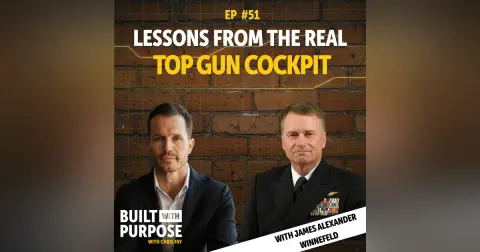


In this remarkable episode of Built With Purpose, Chris Fay sits down with Admiral Sandy Winnefeld, retired U.S. Navy four star admiral, former Vice Chairman of the Joint Chiefs of Staff, Top Gun instructor, and author of Sailing Upwind, for a conversation about leading under pressure, staying calm in a crisis, building elite team culture, and the relentless curiosity that fuels great leaders.
Sandy shares a 37 year Navy career he breaks into three chapters: learning the machine, leading inside the machine, and leading the entire machine. It started in the cockpit of an F-14, flying combat missions and eventually earning a spot as an instructor at the real Top Gun. From there, he went on to command a fighter squadron and later the USS Enterprise, a nuclear powered aircraft carrier with 5,000 sailors aboard. Early in his career he served as Colin Powell's aide, an experience that shaped how he thinks about people, communication, and composure. He closed out his service as the second highest ranking military officer in the country, advising two administrations from inside the White House Situation Room.
Together, Chris and Sandy dig into what leadership looks like when the stakes are as high as they get. Sandy walks through ejecting from an F-14 at night, 700 miles off the coast of San Diego, and the training that carried him through it. He takes listeners onto the bridge of the Enterprise on 9/11, when a ship headed home turned toward Pakistan, and shares how he cut through competing priorities and found the right words to rally his crew before their first strikes. They also unpack the surprisingly humble culture inside Top Gun, the "murder board" that kept everyone sharp, and how Sandy learned to brief presidents in plain language that helped them make better decisions.
Chris and Sandy discuss:
- The three chapters of a leadership career, from learning the machine to leading it
- Why the real Top Gun culture was nothing like the movie's egos
- The "murder board" and how positive peer pressure builds elite teams
- What it's like to eject from an F-14 at night over open ocean
- How "putting your stress in a box" keeps leaders focused when it counts
- The simple fix that got the USS Enterprise to Pakistan on time after 9/11
- Colin Powell's essence of leadership: highest standards and best possible care
In the days after 9/11, Sandy was searching for the right way to speak to his 5,000 person crew before their first strikes. The answer showed up in a local newspaper that mistakenly printed a silhouette of the World War II-era Enterprise. Sandy realized the original Enterprise had also been heading home when Pearl Harbor was attacked, and also flew some of the first strikes in response. That connection became the heart of his message over the ship's PA system.
Key Takeaways
- Never let them see you sweat; your team feeds off your poise
- The essence of leadership is holding people to the highest standards while taking the best possible care of them
- You may be the smartest person in the room, but you're not the only smart person in the room
- In a crisis, stay calm, fall back on your principles, and do the most important things first
- Train your team well enough that you can step back and spot problems before they happen
- Empathy means putting yourself in the other person's shoes, not just feeling for them
Connect with Chris Fay — LinkedIn: https://www.linkedin.com/in/cjfay/
Chris Fay: Welcome to Built with Purpose. I am Chris Faye, and this is the show where vision meets execution and leadership leaves a legacy. From design studios to innovation hubs and product lines to skylines, we meet the people building more than great companies. They're creating culture, driving impact, and shaping what's next. These are the stories and strategies behind how the world gets built with purpose. I am your host, Chris Faye. I am fired up for today's conversation and and you'll see why in in in just a bit, you know, with the topics that we have on on leadership and and and growth and and purpose, you know, having our guest on today is gonna is gonna be not only a true honor, but also something really inspiring for all of you all. So I'd like to I'd like to welcome Sandy Winifeld, Admiral Sandy Winifeld to our show. So Sandy, thanks for thanks for taking some time to join today. Yeah, it's it's great to be with you, Chris. I enjoyed meeting you in Nantucket. And anytime somebody wants to talk about leadership, I'm game. so looking forward to the conversation. Yeah. Well, it's it's gonna be awesome. Yeah, we s we spent some time. I got to meet Sandy at a and he spoke at one of the events that that we hosted in in Nantucket and was telling some of his stories. And you know, you you you have such a great respect for the military and the leadership and government, and then you you get to meet somebody like like you, Sandy, that's done so much in your career. it was just inspiring and then like I I'll sit here and talk about leadership all day long and and you and I had a chance to wrap on that. So I'm I'm so happy you're you're here. And so I've got I've got a lot for us to cover, man. I I told you I was like we can we can talk for we can talk for for hours and hours. I mean, you know, top gun instructor, I mean I've got questions about that. I've got questions about your you know, your your joint chief service at you know, in the federal government and and and you know, leading leading teams in the Navy. Like there's so much stuff that we can we can talk about. I do have to I do have to ask you one quick question though. We had I was just on the c call, we purchased a company back in in March and the founder and the CEO of that company was was a gentleman named Aaron. He served in the Navy. He was a he was a submariner for many years. And so I was talking to him right before the podcast today and I was like hey I was like Have you you know have you have you are you aware of of of Sandy and he said yes and he said he said, I want you to tell Sandy that you bought a company from a bubblehead. So I'm assuming that has to do something with the submarine. Yeah, the the submariners are affectionately known as bubbleheads because they they have to keep what's called a bubble level so that the submarine doesn't go too you know angled down or angled up, that kind of thing. So they're always known as bubble heads. But I'm sort of part bubble head because I did go through nuclear power school, which all those guys have. do. So I do sympathize with them. So what so you're partly bubblehead, but what's the other part? What what would what would you be classified in in your experience in the Navy? fighter pilot probably would be the preponderance of my early career. And you know, I I kind of divide my career into into three my military career into three chunks that I think would would resonate well with your listeners because they probably the senior ones experience the same thing. And one is sort of learning the machine. You know, how do you how do you learn about the ins and outs of this particular business? And that was learning to fly the F-14, you know, learning how to employ it in combat, but also how to land it on an aircraft carrier day and night, that sort of thing. getting the tactics down, being a top gun instructor, that sort of thing. And then and then all of a sudden you find yourself exposed to a leadership position, which I call leading inside the machine, where I'm a ca a commander of a fighter squadron, maybe a small ship, that kind of thing. And eventually USS Enterprise. And then the the sort of last third is leading the entire machine, which your CEOs in your network could very well empathize with where you actually are leading a very large organization. and you know you have to take the lessons and get that right as well. So that's kind of what I am. Well it ha so like in in that, I mean just trying to think about it's a it's a great way to think about that. And and d as you look back at your career, was was there one portion of that that you look back and you're like, you know, that was That was my favorite moment of my career. Or did or did you kind of evolve and change and and really love each phase? Like there was there one of those that you really you really loved the most? Yeah, I really only had one job in the Navy after of thirty seven years that I didn't really particularly enjoy. So I I did enjoy it all. I'd I'd probably pluck two things out of that as as the highlights for me in terms of fun. One was actually being a an instructor at at Top Gun, you know, the real deal, not everybody claims, I'm a Top Gun pilot. This was the real deal. And the culture there, the positive peer pressure, the graduate level flying, that was was really exhilarating. It was an amazing experience. And then later on, being the captain of USS Enterprise, it was incredibly complex, busy. You find that on a ship like that, as the captain, that there are three things you have to do perfectly. One is operate nuclear reactors at sea. you can't mess that up. You're our operating high performance aircraft in the most dangerous environment you can possibly employ airplanes on the flight deck of an aircraft carrier. You have to get that right. And then you're you're navigating a hundred thousand ton ship on the high seas, and you can't run into anybody, you can't run aground. And also when you're doing underway replenishments, you know, 140, 170 feet away from another ship for hours at a time, you can't run into that ship. And you've you discover suddenly that you are the only person on the ship that knows all three. And there's there are plenty of people who are really, really good at one of those things, but you're the only one who knows all three. And that's kind of a my gosh moment. But it's also very exhilarating to have that kind of control over a five thousand person organization. Yeah, and I mean I guess two two things in that. number one is i in that regard, and and when you're in the moment, do you do you do you recognize the gravity of of your responsibility? I mean, I you I feel like sometimes, you know. when we're in the fight, when we're in the hunt. We actually talked about this as on with our leadership team the other day is it's it's hard sometimes to take a step back and to and to have some perspective about what's going on and the situation that you were just in. And then obviously you kind of get to this po point in your career or this point in the day or this point in the year where you actually can stop and and take a breath. But like When you're in the moment and you've got these thousands of sailors underneath you and you're kind of, you know, the nuclear actor and flying and navigating the ship, do you do you recognize the gravity of the role? Or is it just are you just so well trained and so well groomed and groaned for that role that it's just it's just to some extent second nature? You know, I think it's sort of all of the above. I mean, there are moments when you go, my God, I could pinch myself. I'm the captain of a nuclear powered aircraft carrier and and we're a deployed and we're operating and we're in combat, you know, that kind of thing. And you say, you know, you say I have to get this right. I have to stick to my principles. I have to be a good leader and and I have to really pay attention twenty four hours a day, really, to to making sure that this is done safely and professionally and that's right. So so you do catch that. But in the moment when when something is really, really busy busy happening, it it doesn't cross your mind at all. You you're well trained, you're focused on the on the moment. And we actually have in naval aviation a technique that we use. To sort of remove the stress from situations like this. Cause you can't be trying to land an airplane on an aircraft carry at night and be thinking about your financial situation or your parents' health or your relationship. So we literally sort of sort of figuratively tell people to put your stressors in a box in a corner. Think of it that way. And then focus on the task at hand. And then when the time comes to open that box, open the box and deal with the stuff and then put it back in. But it's it's it's sort of a mental game you play with yourself. But it's a little bit of both. Yeah. Yes, probably. You have to you have to be I mean, you have to be able to compartmentalize and and know that I'm gonna set this stuff aside and at some point I'm gonna have to deal with it. Right. And I think probably some of us are better at, you know, coming back and dealing with that versus just kind of pushing it to the side. But no, that makes it makes complete sense. And that and and as a you know, in that in that level of a role, who who do you go to? Like when you when you're leading this team and you you you need you need to, you know. not complain, but you need to get something off your chest. You need to talk to somebody. Like who who are the people that you would go to that you could confide and to either deal with some of those things in the box or or just ask for help and guidance? if you have a dog, you go to your dog. if you need a friend, the dog will always be a friend, although I don't have a dog. I think one of the one of the keys to that is I think just trying to be well grounded and then making sure that the people who are actually working for you Are extremely well trained and able to operate this machine on their own. And that allows you to step back without actually being involved in the day-to-day stuff and watch and and you can pick up on signals of difficulty, mistakes that are about to be made, and you can stop them before they happen. Whereas if you're like totally micromanaging and you're in it all the time, you might miss something as a leader. And in terms of who do you fall back on, I've always had this philosophy that I did not want to hang myself on anybody else's coattails. because if they went down, I was going down. I just wanted people to say, I want to hire this guy because he's good, he's ethical, he knows his business, he works hard. And I didn't want them saying, I w I want to hire this guy because he knows so and so. I I just absolutely tried to avoid that. So I didn't really have anybody that I would call. While my dad was alive, I could always share things with him because he was a former naval officer. But I really didn't do even very much of that at all. It's just kind of a sort of introverted. Hey, I can manage this myself then. Yeah. It's interesting. I I I feel like some people say that about me from time to time. And I certainly if I if I get in a situation where I, you know, I trust somebody and I can confide and talk through things. But like I feel like oftentimes I'm the guy that I kind of put on a happy face. I I want to set the example for the rest of the the team. And meanwhile, like I'm the duck where my feet are kind of going under the water and I'm I might be worried and stressed, but I've I've never, you know, I've never been, whether it's good or bad, never been great at kind of letting letting that out. And You know, it thi it c with that I think I'm curious your your perspective. I mean, some sometimes with that, there's this perception that that you kinda have everything figured out. You know what I mean? Everyone's like, Chris has got it figured out, like no problem, like he he doesn't seem stressed. He seems like he's got all this stuff, you know, doing and and so there's this like balance that I feel sometimes of like wanting to bring people behind the curtain to say, Look, like I'm stressed out, I'm frustrated, I've got these things going on. It's just a thing. I'm like I'm curious, like did you ever did people ever look at you and be like, Man, you know, Admiral Winnefeld like That guy, he's got it all put together. He's got no problems, got no stress. I mean, did you ever feel that that that distance or that pull from your team? Well, you know, one of the things Colin Powell taught me a long time ago was never let him see you sweat. So, and the way I would look at it, I hope this doesn't sound like hubris. You may be the smartest person in the room, but you're not the only smart person in the room. And even really smart people can overlook things. They may miss a detail, they may miss an idea, and it's even though you may be introverted and ab think you can handle things all yourself, you have to listen to the people around you, whether they're the your direct reports who are swimming in their in their lives and they they they might have a good idea. It could be the youngest person down on the deck plates or it could be somebody senior to you. You have to keep that ear open and then filter it all through your own principles, what you know about the business, what you've learned. Because you you know, in a if you're in a leadership position, you're probably the most experienced person on that team. But again, being Being receptive and being a good listener are just incredibly important if you're gonna succeed. Yeah, no, I I I love that. I I have to ask you about the the you know, the the Top Gun experience and and being the instructor. And I and actually you you were you involved in the the original Top Gun filming, if I first movie if I understand that. Yeah, the first the first movie. But you know, I I always I love this quote when I talk to my boys, I've I two teenage boys and we talk about You know, you you are who you spend your time with. You know, if you if you choose to spend your time with people that are driven and successful and doing these things and then you you likely have a better opportunity to do that. And and then, you know, kind of talking about iron sharpening iron. So one of the things that I that I read, you know, and and and have lers listened and learned throughout throughout the years about Top Gun is you've got these you've got the the best of the best pilots coming around one another. And w and one of the things that I I got at ma maybe in your book or in some of the research that I was doing is, you know, there's this perception that it's these massive, like, you know, the movie obviously portrays it as egotistical and competitive and and all of that, but it seems like you had a different experience. Like what what was that like being in that environment? Yeah, we had, I'd say, 17 or so pilots on our staff, Navy, Marine Corps, and we eventually had one Air Force Exchange pilot. And these these really are the best pilots out there. We handpicked who would come to the staff when we had an open based on their performance when they went through the class themselves. There's no such thing as the Top Gun Trophy, but that's kind of the Top Gun Trophy as is and you don't know, you don't know whether you're on that list or not. But so it's really an honor to get asked to to to go do that. And you would think it would be a room full of egos where, you know, Iceman and Maverick are, you banging against each other. And nothing could be further from the truth. We all knew that we were, you know, kind of at the top of our game. we didn't need to compete with each other because we were all going to do fine in our careers if we chose to stay in the Navy. And some of them got out and became airline pilots. and it was just one of those the last thing you, even though we had a lot of fun, we flew well and all that, the last thing you wanted to do was let down your squadron mates at Top Gun. And it was a lot of work. It wasn't just all the glamour of f flying in the air. if you were to give a one-hour lecture, if you were gonna be qualified to give a one-hour lecture to the class, you had to go through, and we invented the term murder board. You had to do present this lecture in front of the entire staff. And it might take an hour to do the lecture. And the debrief where they would just rip you apart tactfully would take as long as five or six hours. And you might fail. So it wasn't like, hey, you're saying to give this lecture. It was like you had to prove yourself that you knew the content, that you had good delivery skills, you could answer questions well. And so it was that kind of an intense peer, elevating peer. environment that was the the best culture I've ever been around. Yeah, I c I I can only imagine it. Like so so do you do you do you still have like those friendships, those connections? Is there is there like this brotherhood that was built and then like you just know that no matter what happens in life, there's a there's a team and I'm sure you've got this throughout your career, but there's a team of individuals that you know that you can go to and if if if you need help or support. Yeah, I mean w the the members of the staff that were there when I was there, you know, when we did the movie and all that kind of stuff. You know, we're not like constantly in contact with each other. But every now and then there'll be one of these little eruptions where something happens and and everybody kind of chimes in and we s you know, support and you know, it might be a tragedy or it might be an interesting issue or hey, the new movie came out. What do you think? That sort of thing. So so we do we are very close and respectful and we really cherish that time that we had together in that moment. most of us were there for two and a half or three years. and hard work together in an exhilarating business is really something Special. So w when I have I'm curious, when's the last time you flew an airplane? Because I mean you you The last time I flew an airplane was in two thousand six. I was a carrier strike group commander, which meant I the Theodore Roosevelt strike group. I had the the carrier, I had the air wing, I had four or five ships, a submarine. And I was very lucky because I was able to fly the F fourteen as a two star admiral. And I was flying combat missions over Iraq, you know, two times a week, eight hour missions, r aerial refueling, you know, two or three times, that kind of thing. It was tiring. So I was able to fly. My last flight was the day of my change of command when I handed over the reins of that carrier strike group to another person and we were at sea off the coast of Virginia and I got in an F fourteen, flew around, landed the airplane twice just to get two more traps, and then flew ashore and my family was there waiting for me and and it was a really special last flight. I can imagine like what was what was that experience like for you? I mean, is it was it D were you were you cherishing each moment or was it you know, and then was it was it coming in to see your family? I mean, what what what was that like for you? Well, it was kind of like what we talked about earlier. I didn't have time for that. Well, you're flying a you know, a bazillion dollar airplane and you're landing on an aircraft carrier and you know, you don't want to screw up your last flight. So it's just total concentration for the hour and a half or so that it took to do that. And then when I landed, got out of the airplane, then it's like, okay, I'm done. And you know, they they hose you down with champagne and all that kind of you know, you would imagine what that would be like. But yeah. It was a it was really special to have my family there on that last day. That's awesome. And and you've you've actually ejected out of a out of a a f F fourteen, if I'm not mistaken. I have. Yeah. What would tell what what I'm just like so curious. I mean, you know, what what's what's that experience like? Yeah, so it wasn't long after we left San Diego heading west on a on a eight six or eight month deployment. And we were you know, you have to stay proficient at landing an airplane on a carrier at night. You have to do about once a week or you fall out of a qualification that causes you to have to do a bunch of day landings before you can go at night. So so we w would just go out and fly, practice radar intercepts on each other, but the real intent of the flight was to get that landing. And so we were flying intercepts and I had a guy that sort of boresided me and I had to get out of the way very, very fast 'cause the 'cause we were potentially gonna have a collision and it was right it was after Dusk, you know, kind of dark and pinky, where depth perception is a real hard thing. Mm-hmm. And the F fourteen did not like sudden maneuvers like that at slow speed. And so the we both engines quit, flat spin, had to jump out at ten thousand feet, seven hundred miles west of San Diego in very rough seas, at night. as quite an experience. But And so do you is it do you have two is there are there t is there is there are two people on the plane or just you? Yes. Two people in the plane and when you when you hit you know the ejection sequence, the canopy comes off, the backseat goes first, and then the front seat goes second. And the reason for that is, you know, you've got w you know wind coming over and you don't want the ro the pilot's rocket motor to fry the the backseater. So the backseater goes first and then and then you go. And it's it's a pretty violent rocket ride up the up the rails there, and then you find yourself hanging in a parachute. D like do you do you remember that moment? I mean, can you kind of replay or is there a moment of then you just kind of block out? Are there moments of of of fear and and or is there just such I mean, you've practiced those moments when it happens? I mean, what's it like going through that and and like do you remember those moments today? Yeah, I do remember seeing the airplane recede below me as I as I rocketed up the the rails. And you're so well trained in the survival techniques and and the ejection sequence itself. That it's it's almost instinctive what you do. it there's actually little acronyms, you know, you remember I rock, I think is inflate your vest, release your life raft, release your oxygen mask and then get yourself ready on what's called your coke fitting so you can release them when you hit the water so you don't get tangled up in your parachute. And you're just, you know, you're going through all of that. And then I I had a a decent, you know, ten minute ride down on the parachute because you're required to eject at ten thousand feet if you're out of control. and I remember there and like, you know, okay, it's kinda it's like I can see a little glow of the sunset, you know, it's kind of pretty up here. Really bummed out that I jumped out of an airplane. I hate that. And by the way, I'm seven hundred miles west of San Diego. I hope they can find me. And then there was an undercast. And going into an undercast was like going into a freezer. and as soon as you go into that undercast, it's pitch black. And now you you are wondering, okay, when am I going to hit the water? 'Cause you really want to get rid of that parachute so you don't get tangled up in it. So going through all of that, I remember it pretty well. and then sitting in my raft for forty five minutes waiting for a helicopter to find me and then hoisting me up. It was it was it was not something that I want to do again. It was not an enjoyable experience, but you know, it was something that I really appreciated the training I had because that's what got me through. Yeah, 'cause got you through it. And so I'm curious, like at in that moment, are you like, Holy cow, that just happened. I'm so thankful to be alive. Or are you like, crap, I just you know, I just crashed a you know a a multi gazillion dollar fighter jet, you know, I've gotta I've gotta answer to somebody. I've got to explain this. Yeah, yeah. What just happened? Yeah. All of that is going through your mind. And you know, you're hoping that your family when they hear about it, you know, hears quickly that you're okay. and 'cause that word spreads pretty pretty fast. But it was just, you know, it was it worked its way out. I was fine. I didn't get in any trouble or anything like that. It was and was flying not too long after that again. You know, and they want to they want to make sure you're healthy. So they'd give a physical to you to make sure that you're fine. And I was fine. My my right foot, I think it was, hit the instrument panel on the way up which severed all of my boot laces, but and gave me a little bruise on my foot, but otherwise I was fine. Okay. When you said severed, I was wondering where that story was gonna go. So I'm glad it was just the just that was just the boot laces. Yeah. Yeah. all right. So then so then I'm kind of fast forwarding, you know, you're you're you're leading the the USS Enterprise, this this massive aircraft carrier and And you you're on you're on the boat. I I believe you're kind of into South Africa area heading either to Cape Town or whatever, and and nine eleven hits. And and you know, talk talk me through what happened there. What was that like? What was the kind of going through your mind? What ended up having to happen once once that once that affected? Yeah, we had just finished we were we were on the end of a six month deployment, we were heading home. We were lit actually right outside the street of Hormuz by, you know, twelve hours or so on our way. Okay. And because we were going to this port visit in South Africa, we had everything all buttoned up for a high speed, rough weather, transit. So everything was all, you know, clamped down. And it was three o'clock in the afternoon our time, which was nine o'clock in the morning on the East Coast here, when my safety officer called me and said, Hey Captain, you need to turn on the TV. And that that was that moment not like everybody remembers because a lot of people tuned in at that time. You know, the commentators are not really sure what's happening. Was this an accident? Was a terrorist act, whatever. And pretty like almost immediately after I turned on the TV, I saw the second airplane hit the second World Trade Center tower. And it seemed pretty clear that we weren't going anywhere. We weren't going to be coming home after all. And there was some, you know, some folklore out there that, you know, I threw my white scarf over my shoulder and without any orders or, you know, enterprise to head back north. Actually, there's a discussion that occurs there. Okay. But what there's a sort of a leadership point there that we we needed to be off the coast of Pakistan the next morning at eight o'clock in the morning. ready to launch airplanes if we if we needed to, because we were pretty sure this was Osama bin Laden. And my navigator came to me and said, Well, well, Captain, we've got to make 25 knots through the water if we're gonna be there on time. And the maintenance people and the flight deck people came to me and said, Captain, we can only go 20 knots because we have to move all these aircraft elevators and we we will normally not run them faster than 20 knots because it's too dangerous. And it it's what happens as a leader when people bring you their problems In their stovepipes in a stressful situation and except you expect you to solve them for them. And this was a fairly simple solution. In retrospect, anybody could think of it. I said, we're going to go 30 knots. And we'll average 25 knots. You know, we're not going to pick just one speed. Sounds so simple, but in a stressful situation, those leaders are going to come to you with their problems, expecting you the the leader to solve them. and and and what was the what was I mean, just trying to think about like from a leadership perspective is, you know, you're a part of any organization that's going through a stressful time, you know, whether it's whatever, like a challenging market or or mergers and acquisitions or, you know, turnover. I mean, whatever. And and and oftentimes, you know, you you look to you look to the leader, you look to the the the person that's that's leading the ship for, you know, I guess direction, but also some level of comfort and and and guidance and vision and everything. So like in in that moment, number one, you gotta execute this this 25, not average maneuver, 30, 35. You gotta tactically run the ship. But I can imagine you got like your your your crew has got these like emotions that are going through their mind about what just happened back at the homeland and Whether it's it's frustration or furiosity or just s scared, like like how how do you how did you in that moment, how did how did you help manage the team's you know, emotions and and and communication and everything? So there are a couple of things. It's a really interesting question. In in the moment, in any kind of crisis, any kind of leader has to do several things. One is you have to stay calm and poised. No matter, you know, like Colin Powell, never let him see you sweat. because your team will feed off that poise. and if all of a sudden you get s stressed and you're you're shooting the messenger and yelling and screaming, they're gonna feed off that also in the wrong way. So number one, stay poised. Number two, fall back on your principles. You know, if you have a set of principles that that operate that govern how you operate your machine or your business or whatever, make sure you maintain, you know, fidelity with those principles. And then making sure that you do the most important things first, not the ones that come to hand. First. Because sometimes some fairly simple things and and leaders in a crisis can kind of dwell on the trivia when in fact they need to be zooming out as the leader and looking at the big picture. What's the most important thing that we can be doing right now? and those those sort of things are what leaders do in crises. And and they they don't try to ma micromanage their their team. They they've already built their team, they've trained their team, they've planned, you know, for that not necessarily this particular crisis, but crises in general, you've wargam those things. And and you just execute. You just gotta execute and stay calm. Yeah. So that's important. And then then another th another thing, you know, it wasn't for until another 30 days before we actually did strikes into Afghanistan. And we were our enterprise had you know, we were the part of the first group that went in there with strikes. And I was looking for a way to talk to my crew that evening in a to in a way that would inspire them and in a way that would have them focus on their job and not get, you know, stressed out. And I was thinking and thinking, what is the hook? What is the hook? And it fell right into my lap. the Virginian pilot, Norfolk, Virginia newspaper put out a full page spread in the paper that had all of the silhouettes of all of the US Navy ships that were out there off the coast of Pakistan. Except that the the silhouette of USS Enterprise was actually the World War II Enterprise, not my enterprise. And I was thinking, what a bunch of idiots here. They got they got the wrong ship. And then it f it it it hit me. It's like, you know, the last time our nation's soil was attacked was Pearl Harbor. And literally there was the World War II Enterprise was on her way home that day and actually was also part of the first strikes against any Japanese entity, and in this case the Marshall Islands. So what a perfect way to talk to my crew. And I've still got a copy of that speech. I still have people come up to me. To this day and say, you know, I remember that talk you gave to the crew the night we did our first strikes. So so as a leader Where where do you do the where do you do this? Where do you do this the the talk? Where do you So we have we have a we have a PA system that runs through the entire ship. Got it. We call it the it's called the one MC. I can hit a button with a microphone and I can talk to the entire ship. I've got everybody paying attention. So gotcha. That was a pretty pretty important thing. And that's what leaders do. Leaders have to find the hook. Whether it's an internal audience or an external audience, what is it that's gonna fascinate these people? What is it g that's gonna focus these people? And it doesn't necessarily hit you right away. Sometimes you have to think on your feet and do that. Yeah. But other times you can be a little more thoughtful and say, What is the message that's really gonna resonate here? Yeah. So I I I I love that. And I you it's it's it's interesting, it's an amazing sometimes like y delivering an inspiring message, how it can really resonate with people, especially in a time of stress. you know, frustration when things are going on. Like we we had something, you know, pop up in the company yesterday and d you know, minor. We were dealing with a with a with a minor issue. And, you know, in the heat of the battle, there was some there was some frustrations amongst the team and we just said, Hey, look, let's just let's just take a break on this for a second. We're gonna regroup tomorrow. And, you know, I woke up this morning and you just kind of have these moments of clarity, right? And whether they come to you in the you know, to your point when you're looking at a you know, at a Virginia publication or f for me, I I I just kind of woke up out of bed this morning and I just I just had this clarity come over me and I walked out there and I was having a cup of coffee and I ended up, you know, just kind of coming up with with some thoughts and ideas about how to rectify the situation yesterday that I that I couldn't necessarily see, you know, when I was in the midst of it. And so we use that today to, you know, to to hopefully help settle and and communicate these issues out. But yeah, it's it's interesting, you know, I I think sometimes as leaders You know, we we know that we we need to inspire and motivate the teams and but but I think sometimes we can get not not lazy, but to some level of complacent to say, you know, may may maybe maybe I don't need to say something inspirational here. Maybe they've heard this from me before, but I feel like it really it really carries a lot of weight with with with the people that you're leading. Yeah, and I think a good leader is I don't wanna s sound like it's you know, all work and no play, but y you you really are working twenty four seven. And it's sometimes unconscious in the back of your mind. And you then a a good night's sleep waking up in the morning. You know, I wake up all the time in the middle of the night going, Eureka, you know, th you know, this I either something I've got to do that I forgot to write down or an idea that pops in your head. So as a as a good leader, your mind is always kind of got that little noise in the background that might help you come up with that message. Yeah and and as as Colin Powell also told me, you know, it's the news is never as bad or as good as you think it is. Yeah, there was a there was a friend of mine. And it's I I want to pivot to your your your time in Washington and you know working with under Colin Powell and then ultimately the Joint Chiefs and you know in the in the situation room. But but you know the the working under people like that. I mean I've heard you quote Colin Powell two or three times and obviously he's probably somebody that's had a had an impact on you and an an inspiration on you. But yeah, those those moments of when you when you come up with a thought or an idea. And I think that's maybe a benefit and a detriment of thinking about work or whatever you're doing all day every day. But, you know, I'd be with my kids or out on a on a on a run or, you know, in the midst of something and you you're you're able to you're able to come up with an idea and get and get it down and get it out. So but let's let's pivot to the to your time, you know, kind of leaving to some extent the the the leadership of the enterprise and and you know everything that you were doing there. And kind of moving into this world with Colin Powell and ultimately the joint chiefs and working in the situation room. I mean, that was a whole nother chapter of of your life. I mean, t tell me tell me about that. Yeah, so so I actually worked for Colin Powell when I was younger. I was his horse. I was his aide carrying his bags and all that. But it was a opportunity to observe him and how he did you know, life, how he did business. How he would write a speech on three by five cards on the way to a speech and and it'd be masterful. You know, just watching how he How he treated people. one of the great lessons he taught is that very simple. The essence of leading people is holding them to the highest possible standards while you take the best possible care of them. And if you do one and not the other, it doesn't work. But if you do both of those, it's magic. So setting that aside, after I was captain of enterprise, I went to another job and then eventually got selected to be a one star baby admiral and and then work my way up through those admiral ranks to eventually, as you point out, become the vice chairman of the joint chiefs of staff, which is the Number two ranking military officer in the in the entire military. And similar to Enterprise, where I told you there were three things you had to do perfectly. Here there were really sort of three bins that I had to to live in. One was as as with in partnership with the Deputy Secretary of Defense, essentially manage the budget for the entire department. What are we going to spend our money on? and then another one was the policy thing that I did with the Under Secretary of Defense for Policy. with those thousand White House situation room meetings going across the p Potomac River to those meetings that where where lots of important topics were discussed, like w what elements of national power are we going to use? Are we going to use force? How are we going to do it? Those sorts of things. And then the third thing was a sort of a personnel thing where not only are you trying to figure out who our replacements are going to be and sort of succession planning for the the you know senior levels of the force, but also, you know, as as Bill Gates or Bob Gates used to say, when you have a million people in your force, there's usually somebody doing something you really wish they weren't doing. Yeah. And and kind of dealing with that, you know, and you know trying to dramatically reduce, hopefully to zero the rate of unwanted sexual contact in the military, those sorts of things. So similar to enterprise, there were those three things and and I had people I worked with and who worked for me who were very good at one thing. But nobody, literally ha including the Deputy Secretary of Defense, had his you know, his arms around all three. So I had to be an expert in all three things and it w again sort of an exhilarating thing, but it was kind of a grind. Washington DC is not the most fun place to operate. But it was you know, I felt like Forrest Gump, you know, kind of being in the you know, somehow I got in the right place at the right time, I don't know how. Yeah, but you know, you make the best of it. and it was quite an experience for me. Yeah, and w and like I guess that like that first time that you're called in in front of the president and they're they're ask they're looking to you to guide and advise. I mean, kind of the similar question that you had earlier. I mean the the the the gravity of that moment, are there nerves through that or are you so comfortable in your your role and your expertise that you're able to contribute? But I just think about that first meeting, I sit down and they're like, you know, Admiral Winnefeld. Yeah. I don't know why yeah, I don't know why. I'm not taking any credit for this, but I was always very comfortable in those situations. And it was sort of like, what are they gonna do to me? You know, make me retire and I'll go off and and you know, have a nice life? or you know, I'm not gonna go to jail for, you know, not performing well. So, and it was it's a in the White House sitroom, either a national security council meeting or a deputies committee meeting, which is like one echelon below, there are really, really smart people sitting around that table. And I worked in both the George W. Bush administration and the Barack Obama administration, and all these people were patriots. They had the best interests of the country at heart. They had very, very similar approaches to national security, believe it or not. And they worked their tails off and they were all very smart. But n they basically knew nothing about the military. If you're the deputy treasury secretary, you know everything about finance and about treasury, but you don't know anything about the military, and so on down the line. So if we were gonna go, let's say, rescue a hostage in Somalia using special operations forces, I was the guy who kind of briefed that in order to get a decision to do it or not do it. And and and the I really concentrated on on giving a a quality brief that was not perceived as either bowl rushing them, like you have to do this, just you know, don't say no. and not having, you know, acronyms and lingo and all that kind of stuff, but trying to boil it down, distill it down to something they could understand, where they understood the risks, the risks to mission, the risks to our forces. That sort of thing and they could make a a a good decision. And then there was a little technique where you always hold one obvious question out that you don't preemptively brief and and you know it's gonna get asked. It gets asked You put you give a killer answer and that just builds the confidence of the room. Yeah, that's right. That's right. sir, I've got to ask you just one quick question. really? Amazing answer. Amazing answer. I'm glad you asked that. Yeah. Yeah. So so but it was it was an exercise and really something an uncle of I had a long time ago that taught me, you know, this term empathy that people misinterpret as sympathy. empathy is really putting yourself in the other person's shoes. Whether you're whether you're doing a negotiation or you're in an argument or you're just trying to brief them on a very important operation to rescue a hostage, you really want to trans translate yourself into their shoes and go, you know, how what are they hearing from me? Are are they going to understand what I'm telling them? Are they going to be skeptical? Is my body language right? You know, that sort of thing. And that is just so important in almost any human action. interaction that you have is that sort of empathetic piece of understanding who the other person is. Well and I so so just kind of curious and that and not, you know, everybody's got their own political views, but y you said something a second ago when you you were talking about, you know, you you work under more of a r a Republican administration, you've worked under more of the d the the Democrat. so you've seen certainly both sides and and you made this you made this mention that, you know, in in There's probably differences amongst everybody. I'm sure you see kind of the far right and the far left. But it I just heard you say something that, you know, most most people in in both of those kind of they kind of saw things to to some extent in a in a bit of a similar fashion. And I think like today, as just a civilian that's trying to run a business and raise a family and you know, you watch the divisiveness of what's happening on the news and and you know, I think that the the the world programs us to say you have to pick a side. There there's no There's no middle ground. And I've always really just believed and held true that the average American is is actually not as far apart as we think that we are. And and it comes into the fact of when you're talking about, you know, empathy and and you can be very critical of somebody that has a different viewpoint from them. But when you actually spend your time to listen and learn of why they developed that that, you know, what their previous experiences are, where they're from. So I'm just just kind of curious. Like when you are in those environments, d Do do you see the level of of d divisiveness that that we see as civilians or or is our government more aligned or at least at least working better than than maybe we would perceive it to be? Yeah, it's a really good question, Chris. It's changed over time. I I've had to testify in front of Congress a lot. And in the earlier days when I was testifying, let's say in front of the Senate Armed Services Committee, you'd go in their sort of back room where they would gather and just kind of, you know, politely introduce yourself, that kind of thing. And you'd have Republicans and Democrats, you know, slapping each other on the back. Hey, how are your kids doing? You know, how you know, how was that hunt you did last week? And, you know, da da da. And they were friends. Even though they disagreed on a lot of the issues, they were friends. And these are people like Sam Nunn, and Richard Lugar, and you know, th you know, the old guard, right? And over time it it turned into more of a they just wouldn't talk to each other. And it was very obviously it something happened that caused that. And I sort had this theory in my head that, you know, in in the post-World War II environment, the the left-right attitudes of the country were sort of like a hump, like a bell curve, where you know you had a few people on the right, a few people on the left, but generally we all kind of thought the same way and you know a few disagreements here and there, you know, with some people in the tails. And then when twenty-four hour news media came out, and those companies realized that if they were gonna have audiences, they had to pick a side. So then you see that that bell curve breaking into two humps, and that those humps start to move apart. and and then the division started to occur. But we were still, you know, kind still a kind of a civil society. And with the advent of social media, each of those two humps is now broken into two, where you have a very far right, a very far left, and then kind of a moderate right and a moderate left. and the moderate right and the moderate left kind of get along, but but it's it's getting harder and harder and harder because of. primaries because of gerrymandering and and y you know you you almost have to take an extreme position even though you may not believe in it if you're a politician in order to get reelected. And that's that's a danger to the country. So I I try to to urge people to do everything you can to think for yourself. Arm yourself with the with the the history, with you know, whatever it takes to be able to to take a look at something and and not just you know go to Facebook and see what all your buddies are saying. But really think for yourself and have the courage to, when you need to, express those views. and we need to teach our kids to do that as well. If we don't do that, it's only gonna get worse. Yeah. Yeah, and it's it's it's scary. And I and I and I agree with you. I mean, I've got a, you know, like I said mentioned earlier, two teenage boys, a 15 year old and 17 year old. And, you know, earlier on we were I would say we we were late in allowing them to have access to technology and some of the things that we were, but then, you know, as a 17 year old, they're in Like they're they're they're in it, they're on social media, they're connecting with their friends. I mean, that's how they communicate and connect. And, you know, it it's interesting, just the environment that they're in. And, you know, we live in in South Carolina and they, you know, they they hang out in certain areas and such. And, you know, this this the the information that's fed to them, right, specifically versus the information that might be fed to me or or fed to you is wildly different. And so we'll we'll talk about the same topic. You know, we'll something will happen on the news and as a family will say, you know, hey, gosh, what do what do you think about that? And there'll be these polarizing opinions that are coming out from our family just by nature of where we consume our information. You know, but then meanwhile, if if we take the time to come back and say, All right, hang on a second. We've all established our own independent opinions. Let's come together like is this where do we really feel about this? I feel like when you talk about it, you can kind of begin to come back, but then everybody to some extent retreats to their corners and it's it's it's scary, you know, and no matter what you know, what side you lean, you know, it's it's scary and you know, as an American, you just you just hope and pray that there's not this level of divisiveness because you think about like if if we're fighting like this internally, you know, obviously we're opening ourselves up to other countries. And I know this is something you talked about of, you know, some of our adversaries would love to see us continue to fight and break ourselves apart. Yeah, and the social media feeds the algorithms are are very good at reinforcing You know, so you know, all you have to do is click on, let's say, I'm interested in buying a Volkswagen. You, you know, how many Volkswagen ads are you gonna get in your social media feed for the next week or so? Well, the same thing happens with you know attitudinal things, and and it's a reinforcing echo chamber. And it's it's almost an interesting exercise to go into your social media and just somehow, whether you do it on a website and your social media picks up on it or whatever, ask a question about the other side. and Y you'll confuse the whole the whole algorithm 'cause it doesn't know what to feed you. and and really being skeptical because and I I sometimes I will unfollow people just because they they've gone way over the over the brink. In in either direction, left or right. Doesn't matter to me. I'm an equal opportunity critic. Yeah, well other on on both on both sides. Well and I and obviously and in your in your role in the in the joint chiefs, I mean you're you're you're serving you have to serve to some extent independently, right? 'Cause you're serving both sides and both different areas and they're looking to you to not not pick a side. One of the interesting things, Chris, in both administrations that I was under, is that inside that situation room on the national security side, not one single time in thousands of meetings did I hear anybody say, you know, we need to kind of go in this direction because you know the because the next election's coming up. There was no political piece in that. Now that probably happened outside the room. But inside the room, it was first let's get the intelligence briefed so we get the facts straight on what this situation's about. Let's do a cold look at what all the options are that are out there. Let's let's see where the national security interests are that are at stake. And then let's come to a conclusion on what we should recommend to the president that we do. It was a very interesting and refreshing approach. Now, you know, I can't speak for politics outside that room because they've gotten ugly and divisive and crazy. But inside that and I can't even speak for the way it is today in this administration, I just don't know. But in the two administrations I worked under, it was very positive and and really focused on 'cause when you're sitting at the end of that White House situation room table and you've got the best facts from the intelligence community of anybody on the planet, and you've got lives of young men and women at stake if you're gonna do something, you know, it kind of comes home to Roose, like, this is really serious. I've got to get this right. Yeah. I can I I again kinda d to the gravity. I mean, you've had so many moments in your life of of this extreme extreme weight and gravity, the decisions that you're making. And but you know, it's comforting as a as an American to say, you know, and to hope that's still the case is that, you know, with these critical decisions about our military or what we're doing, that, you know, we're setting the politics aside and let's really focus on what's best, you know, what's best for our country, because we need to maintain that maintain that strength. So All right, I got I gotta I I could I again I told you I could prep you. I could I could I could run this for three hours, but I'm trying my best to make sure I I preserve your Friday afternoon because I I I could literally could sit here and talk to you for hours. I I do wanna pivot kind of to to kind of post you know, post career. You you you you now serve on a number of boards. You you know you're advising a a variety of organizations. You and and you wrote you wrote this book called Sailing Up Wind, that's about you know, really a bit about your story, but I loved I loved how you broke out as I was reading your book and and then kind of going back to some of the the key recaps, this idea of, you know, leading yourself, leading people, leading organizations, leading execution, leading change. So I d I do want to make sure we talk about that. So so I guess kind of as you've gotten into more of the civilian life, you know, you know, what's that been like and then and then what inspired you to to to put this to put this book together? Sure. So on the first thing I I had the opportunity if I wanted to to throw my name in the in the ring to be the next chairman of the Joint Chiefs. But I'd done the vice chairman thing for four years. I you know, I didn't want to do another s insulting Senate confirmation hearing and I kinda checked that block, right? I really wanted to get into business. I wanted to understand that world and and I wanted to learn something new. 'Cause I have a theory that if if if you if you're not continually learning and if you're not continuing to do something that nature will spit you out. If you go down to Florida and just play golf, you know, some people could do that, but I can't. I would be dead in six months. So I wanted to do something new. And I really wasn't sure the culture and the people I was going to experience in in a business world. And and I was either I've been lucky or or it's, you know, I've been very pleasantly, I wouldn't say surprised, but pleased by the quality of the individual that I've been able to work with on these different boards. And an enterprise rent a car, privately held non defense. to Raytheon, publicly held defense and everything in between has been a really great learning experience for me. I couldn't spell Ibita back in twenty fifteen and now I can write a pretty good essay about that, right? and then in between, you know, being the chairman of the President's Intelligence Advisory Board was a chance to serve without actually going back into government, which I will never do, and you know, a number of of nonprofit pieces, the podcast, that sort of thing. As far as the book goes, I retired in twenty fifteen in the summertime. My father was was undergoing pancreatic cancer at the time. And he told me, you know, Sandy, you need to you you've had an amazing forest gump-like career. You need to gather your thoughts together and and write it down, not you know, for profit or anything like that, but to help the next generation understand what what, you know, they may go through. And I was like, Shh, I don't want to write a book. You know, come on, I got other things to do. And then he passed away on Thanksgiving that year. And so what are you gonna do? Not write the book your dad told you to write? Right. Right. And and so I experimented with it. You I'd write a chapter on an airline ride or something like that. And it turned out that, you know, I thought I think I could probably do this. And I I didn't realize how hard it was because, you know, I I I I didn't have a you know a ghost writer or anything like that. I did it all myself. And I really wanted to weave in these leadership themes you just talked about, the anchors. And I I was struggling with how to do that because you can't do them. necessarily sequentially, because you learn all five of them in parallel throughout your life and your career. So I decided every third chapter or so I just break it up into an anchor and and cover those leadership pieces that I really believe in. And trying to simplify a very complicated subject that leader leadership is. There's no one sound bite that you know turns you into a brilliant leader. And I was trying to capture that in a very, you know, understandable framework so that as people learn learn things about leadership that can kind of hang them on that framework as they go. And it turned out to be a really rewarding exercise. It was it was it was funny. So I when I I've listened to you you know, obviously speak in in front of our group and had some time to to speak with you. But but I I that's that's also a bit of how you're how you're wired. And I like it because it's the way that I'm wired as well. So you know, a couple times through the podcast, you know, you're like, But blah, blah, blah, you know, and there's and there's three things, you know, and then there's there's four things that that that drive that. And I think it it makes it so much easier to consume, you know, the content. Be yes, it was the four things, you know, the the five anchors about yourself, your people, you know, organizations, execution and change. It's just it makes it much more digestible. Like for me, I'm I'm a bit of a a bullet point remembering remembering those things as far as a concept. So yeah, it's it's spoke it spoke really well. And and and so just just kind of briefly talk talk me through so this this idea, I mean it's kind of the You've got, you know, leading yourself. It's kind of your own individual, you know, character and what you're doing. You talk about then people and organizations and execution and change. Like what what's that what is that whole experience like and kind of carrying us through? Yeah. And you know, I think there are three things you have to do if you're gonna learn to be a leader. One, you have to study, which means reading. And you can either read books about leadership and there's some really good ones out there, and you can read biographies and you know, hey, how did this person think? So that's one. another one is observing the leaders around you that you've either worked for or you're alongside or what have you and learning as much as you can from them. and then the last piece is is practice, right? Run to the sound of the guns. When you're ever given I tell young people, particularly in college, it's like somebody gives you a leadership opportunity, seize it because it's free in college. You can make all the mistakes you want in college in a club or a fraternity or a sorority or something, and you're gonna learn so much that you'll apply to a later thing. So if you If you do all those three things, it's really useful to have a framework, a a way of organizing your mind around that, and and maybe even a piece of paper in front of you on your wall or something. And so, you know, the leading yourself piece was you and you hit the nail on the head, you know, it's about character, you know, courage, integrity, empathy, and those sorts of things. lifelong learning as part of leading yourself, you know, committing yourself to what you're doing, and then managing your brain, the stress. That you can go through those. Each each one of these anchors has four threads, and those are kind of the four on leading yourself. And then on leading, you know, people, it's building an awesome team, connecting with your people, genuinely, the high standards and high care piece, and then developing trust and teamwork in your own organization. That's about leading people, leading organizations, setting your culture, thinking strategically, understanding how power works, and then the art of communicating is terribly, terribly important for a leader, both writing. speaking and we can talk for hours about that, Chris. Yeah. And then leading leading execution is is, you know, leaders are deciders. you want to drive operational excellence. Another list of six things from the nuclear power program that I learned that are powerful in terms of driving excellence. Embracing risk and adversity, not running away from them. And then measuring your your results wisely because you can you can chase the wrong metric and ruin your business. And then of course leading the change is is you know challenging all the assumptions. I have a great saying that I love that's Incredibly bright adults will work unbelievably long hours perfecting fundamentally flawed concepts. We've all seen it. You know, the people who challenge the assumptions, the Steve Jobs of the world, those are those are the people who are going to make a difference. And then leading a creative process, overcoming the resistance, and then being bold about implementing change. Those are all really important things. And it's a very you know, that's 20 things I just went through. very, very important to try to master all of them if you can. Yeah. It's a it's a journey. Yeah, I mean I I I I really enjoyed, I mean, reading the book. It was a it was amazing. Like I said, I could I could talk about leadership for for hours and hours and just the way that the way that you dissected everything down was very helpful. And it's something we've we talked about as a leadership team today about, you know, studying studying your book and and having this as a part of our our conversation. So so so as as we kinda wrap up, Sandy, I mean f first off, y you know, it it's amazing. You've said Forrest Gump a couple of times here and just you know, you think back about your life and And what you've accomplished and especially for you know for a civilian that, you know, you know, I've I've I've done things in my life, but but you know, listening to the things that you've done, it's just amazing, man. It really it really is. And I mean so so proud to have people like you that have have served this country for for so many years. and so I just just I I have to just kinda ask, like, as you think about where you are today, you know, and and you know, you're you're still leading, you're still inspiring others, you're you know, you're traveling, you've got you know got your your family and others, like is is there just one thing that you either look back upon or you think about on a day to day basis that that kind of defines who you are or or or how you operate? Is it just kind of one core concept or one core thing that that you you just take with you each and every day? Yeah, I I probably don't consciously think of this every day, but I kind of live it. And I I owe this to my mom. I owe my dad because he was a man of service and integrity, deep integrity. And I always tried to follow his example. My mom taught me to read when I was four years old, because we were living in Italy and I didn't have any friends there and I didn't have anything to do, so she taught me to read, which kind of kindled a lifelong curiosity. So a a relentless curiosity of trying to chase the the the thing all the way to to the ground. and and learning something new either inside whatever profession I'm doing or alongside that profession or something completely outside that my profession, that has been a real enabler for me. Because, you know, the essence of creativity is is is of somebody putting together two disparate things that have never been put together before. And you have to do the work to understand what the art of the possible is. And I can give you examples, galore, about when when that's happened to me because of my mom inspired me to be a lifelong learner. and so I think that relentless curiosity is probably the one thing. And I just I just I just have this I can't stop, you know. My wife hates it. She can imagine energizer bunny. It's like babe God, can you just sit down for a minute and hang out with me and you know, have a glass of wine. Why you always want to do something? And then the other thing is and you alluded to this earlier, Chris, really important to surround yourself with the right kind of people. You know, you are who you associalize with and who you do work with and and being around high quality people, I I I have no patience for people who are not high quality people. Yeah. and you know, it at anything. They it could be musician or they could be anything. I'm deeply curious about how did you get to be good at what you're doing? That's why we do my partner Sandy Magnus, who's a retired female astronaut and I do the podcast The Adrenaline Zone. we really want to hear from people who have accomplished a lot and taken risk along the way. Mm. what were you thinking? Whether it's Joseph Newgarden, India IndyCar champion, or whether it's a gal who's climbed all the highest mountains on the planet, or whether it's investment venture capitalist who almost went to jail because he had twenty eight credit cards maxed out, and then an angel comes in and rescues him and then he made like a billion dollars. It's these are fascinating stories of of really interesting people who've who've pushed. Yeah. Well and and it's amazing. I mean our our our society is filled with fascinating people. And I and I agree with you. I mean, it's so my my my wife gives me a hard time. We we were we'd be notorious. We love to go to the coast of South Carolina to Charleston. It's one of favorite places. And you know, I'm notorious for well she wants to sit on the beach and and read. And I'm always like, hey, you want to go for a walk? You wanna, you know, we don't I used to want to throw the football with her, which she didn't want to do. And and now I've got boys to go to go do that with. But always always thinking and and and doing that. But there's so many people and and I c I think it comes back a bit to your Not necessarily empathetic, but you talked about the empathy of wanting to listen and learn to to to the other side to understand, you know, why they're feeling the way they are. But that that's also just how you listen and learn about the world in itself. You know, you you you you experience things from people that have done things much differently than you or have different perspectives from you. And you know that's one thing I've certainly in s tried to instill in my boys is just to be c to be curious, man. Ask questions. And I I remember it's the same thing I tell new leaders, you know, what what what's one of the things that that can help me be a new leader? It's like Man, get involved. Like roll your roll your sleeves up. Ask questions. Like just make mistakes. Yeah, make mistakes. You know, bust your bust your face up a bit. It's o it's okay. So well, Sandy, I as as we're closing here, man, I just I just can't thank you enough for taking the time to to hop on built with purpose. I think I think you know listeners are gonna really, really enjoy our conversation today. And certainly you can you can Google tons of stuff about Sandy and and his book and his his history, and I just really encourage our listeners to follow, but man, I can't thank you enough for taking the time to spend Friday afternoon with me. Well, it's a it's been a real pleasure, Chris. And one thing I like to leave audiences with in in the business environment is, you know, a lot of people come up to me and say, thank you for your service and all that kind of stuff. And I always try to deflect that back. People in business are creating jobs. They're creating economic vitality for vitality for our country. And no s strong nation ever had a weak economy. So you may be out there, you know, with a massive auto parts thing or you may have, you know, whatever. You're doing important patriotic work for our country, so I thank you guys. Okay, thanks for joining me on Built with Purpose. If you have enjoyed today's episode, subscribe, share, and leave us a review. It helps more bold leaders find the show. For resources and show notes, visit our website and connect with me, Chris Fay, on LinkedIn. Until next time, keep building great companies, cultures, and legacies with purpose.


